Content Gaps in SEO: How to Find Topics Missing from Your Website?


Blog development often starts with the question: “What else can we write about?” That’s not enough. A much better question is: “What answers are missing from the site, even though users and competitors have already shown that the topic matters?” That’s what a content gap is all about.
A content gap helps you identify gaps between what’s on your site and what users are searching for or what your competitors are covering. It’s not about chasing every possible topic. It’s about selecting the gaps that can increase organic traffic and strengthen your site’s expertise.
Content gap analysis pairs well with an SEO audit because it reveals not only technical errors but also untapped content potential.
You can find more content like this on our blog.
Key Takeaways
A content gap is the difference between the topics that should be covered on a website and those that are missing or covered too superficially.
A good analysis isn’t about copying the competition. Its goal is to understand where users aren’t getting complete answers and how you can create better content.
Content gaps can involve entire articles, missing sections, FAQs, examples, comparisons, definitions, or links to services.
What can you discover through a content gap analysis?

Most often, it turns out that a website has general content but lacks intermediate and technical topics. Example: a company describes SEO but has no articles on indexing, canonical tags, structured data, or sitemaps. For Google and the user, this means incomplete coverage of the topic.
- keywords for which your competitors rank but your website does not,
- topics requiring separate articles or sections,
- user questions that haven’t been addressed yet,
- old posts that need to be expanded,
- areas where links to services are missing.
How to perform a content gap analysis step by step?
- Define the area you want to develop, such as technical SEO or service pages.
- Select organic competitors, not just business competitors.
- Compare the keywords and topics that your competitors are driving traffic with.
- Assess whether a given gap aligns with your offerings and expertise.
- Decide whether you need a new article, an update to an old post, or an expansion of a service page.
It’s worth combining this analysis with content marketing, because not every gap should result in a new piece of content. Some topics are better suited for an existing post or a service page.
When can a content gap be harmful?
Gap analysis can lead to content overproduction if every topic identified is mindlessly added to the calendar. This is a surefire path to content cannibalization and a dilution of your niche.
It’s worth rejecting a topic if it doesn’t fit your offering, lacks a clear purpose, or duplicates an existing URL. In such a situation, it’s better to update the article, especially if it’s already generating views in Google Search Console.
How to integrate content gap analysis with link building?
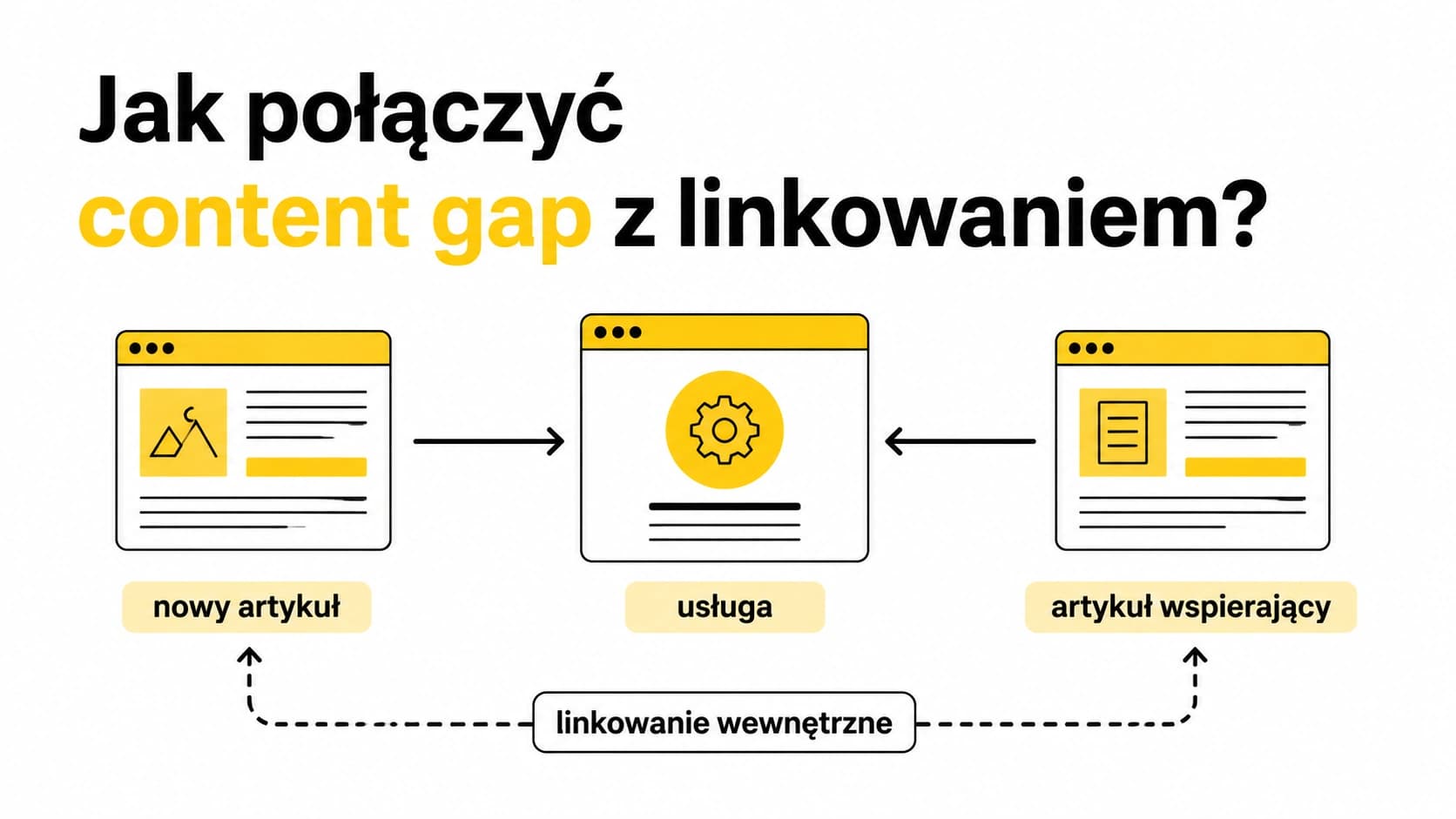
A new article should immediately find its place within the site’s structure. If it describes a technical issue, it can link to an SEO audit. If it expands on a content topic, it should lead to copywriting or content marketing. If it relates to the user journey, a natural context is a post titled “Customer Journey and SEO.”
Without this, new articles will exist but won’t necessarily be effective. Linking transforms a content gap from a list of shortcomings into a real plan for the site’s development.
Expert Insight
The best content gap analysis culminates in a decision: what to publish, what to update, what to link, and what not to do. It is precisely this last category that is often the most important, as it protects the site from content chaos.
How do you distinguish a real content gap from an apparent one?
Not every phrase that competitors rank for is automatically a topic worth writing about. A true content gap exists when the missing content aligns with your offering, addresses a real user intent, and can strengthen the site’s structure. An apparent gap is a topic that looks attractive in a tool but doesn’t drive the right traffic, queries, or decisions.
For example, a marketing agency might find many phrases related to general marketing, trends, or definitions. Not all of them should make it into the plan. If a topic doesn’t support SEO, strategy, websites, Google Ads, UX, or another area of the agency’s offerings, it may generate traffic that has no business value. Good research isn’t about collecting as many gaps as possible, but about selecting the ones that build visibility in the right direction.
- True gap: the topic has search volume, search intent, and relevance to the offering,
- Apparent gap: The topic has traffic but doesn’t align with your services or target audience,
- gap to be updated: the topic partially exists but requires expansion,
- gap to merge: several pieces of content address similar questions and need to be consolidated,
- gap to be discarded: the topic would fall outside the website’s strategy.
How to use content gap analysis in a publishing plan?

The best outcome of the analysis isn’t a long list of topics. The best outcome is deciding which articles to create first, which existing articles to expand, and which topics to set aside. A content gap analysis should lead to priorities, because in SEO, not every publication carries the same weight.
In practice, it’s worth evaluating topics through three filters: traffic potential, difficulty, and business impact. A topic with high search volume but low relevance to your offering may be less valuable than a smaller topic that reaches users closer to their decision-making stage. On the other hand, when building significant organic traffic, broad topics are also necessary—provided they lead to a well-designed content cluster.
Content Gap Assessment Checklist
- Does the topic answer a question that the current page does not cover?
- Can the existing text be expanded instead of creating a new URL?
- Does the topic have a distinct intent compared to other articles?
- Do the sources allow for creating expert content rather than general content?
- Can a service or supporting post be naturally linked to after publication?
- Does the topic help build long-term traffic, rather than just temporary visits?
Example of Application in a Real-World Project
Let’s imagine a situation where a team notices that competitors are driving traffic for search queries that aren’t covered on their current website. At first glance, this might seem like a single technical or editorial issue, but in practice, it usually involves several layers simultaneously: content, structure, data, UX, and business objectives. That’s precisely why a content gap shouldn’t be analyzed in isolation from the entire website.
The best approach starts with a diagnosis. Before creating a to-do list, you need to determine what’s actually holding back results: a lack of content, an unclear structure, poor measurement, incorrect implementation, or a mismatch with user intent. Only then can you decide which actions have the highest priority and how to measure their impact.
In practice, the process involves: comparing domains, analyzing search queries, and deciding whether to create a new article or expand an existing one. This approach prevents you from haphazardly trying to fix everything at once. Instead, it allows you to select the elements that have the greatest impact on visibility, traffic quality, conversion, or the user’s decision.
How can you deepen your analysis before implementation?

Before implementation, it’s worth asking a few key questions. Thanks to them, the “content gap” ceases to be just a buzzword and becomes a concrete decision-making process. The answers to these questions should be based on data, sources, user behavior, and an analysis of the current website structure.
- What user problem is this change intended to solve?
- Does the current website already partially address this intent, or is new content or a redesign needed?
- What data confirms that the problem actually exists?
- Which subpages, forms, campaigns, or content will be affected by the change?
- How will the impact be measured after implementation?
- Will the change cause new cannibalization, duplication, or a deterioration in UX?
What should the reader understand after reading this?
After reading a well-written article, the user should understand not only the definition but also the consequences. They should know when a content gap matters, when it’s a secondary issue, how to identify the problem, and what mistakes to avoid. This is especially important in expert content, because readers often aren’t looking for trivia, but rather a practical answer to the question of what to do next.
It’s also worth outlining the scope of the topic. Not every action carries the same priority for every company. For a small service-oriented website, a clear offer and a contact form may be more important, while for a large website, technical indexing checks may be more critical. For a campaign with a small budget, the quality of search queries may be key, while for large-scale campaigns, path analysis and attribution may be crucial. Premium content should help distinguish between these situations.
Mini-checklist for quality before publication or implementation
- the content addresses the main intent, rather than merely defining a concept,
- headings guide the user from the problem to the solution,
- examples illustrate real-life situations, not abstract ones,
- Practical sections explain what to do and why,
- The FAQ answers the reader’s questions, not the needs of the author,
- sources support specific parts of the content rather than serving as a random bibliography.
If the text meets these conditions, the content gap is explained not only correctly but also usefully. This is what distinguishes an expert article from a basic SEO post: the user doesn’t finish reading with just a definition, but with a real understanding of the problem and possible actions.
FAQ
Does a content gap always mean you need to write a new article?
No. Sometimes it’s enough to expand existing content, add an FAQ section, refine the headings, or strengthen the internal linking. A new article only makes sense if the gap represents a distinct search intent.
How do you distinguish a content gap from an unnecessary topic?
The topic should be relevant to your offering, align with the user’s actual intent, and allow you to provide a better answer than the competition. The mere presence of a phrase on a competitor’s site is not a sufficient reason to publish.
Does a content gap help build topical authority?
Yes, because it highlights the missing elements of a content cluster. This allows you to fill in the content structure in a planned, rather than random, way.
Summary

A content gap is one of the most practical tools for growing organic traffic. It helps you identify topics with potential while preventing you from publishing content that serves no strategic purpose.
It provides the greatest value when combined with search intent analysis, site structure, and internal linking. Then, every new publication has a purpose, a place, and a direction.


