SEO Structured Data: How Does Schema Help Google Understand a Website?


Structured data is like labels added to a webpage’s content. Users usually don’t see it, but it helps search engines better understand what an article, company, product, FAQ, or event is about.
SEO structured data does not replace good content. However, it can help Google correctly interpret elements of a page and qualify it for rich search results. Combined with SEO optimization and good content, it provides technical support for visibility.
This topic is particularly important when developing blogs, service pages, and expert content. The article on GEO vs. SEO shows how the importance of information structure is growing, especially in the context of AI tools.
You can find more content like this on our blog.
Key Takeaways
SEO structured data describes a page’s content in a way that search engines can understand. Thanks to this data, Google can more easily recognize an article, organization, FAQ, product, review, or local business.
Schema is not a guarantee of rich results, but it improves the readability of data for search engines. It’s a technical element worth implementing wherever it supports actual content.
The greatest value comes from combining structured data with proper site architecture, indexing, and content that addresses the user’s intent.
What is structured data?
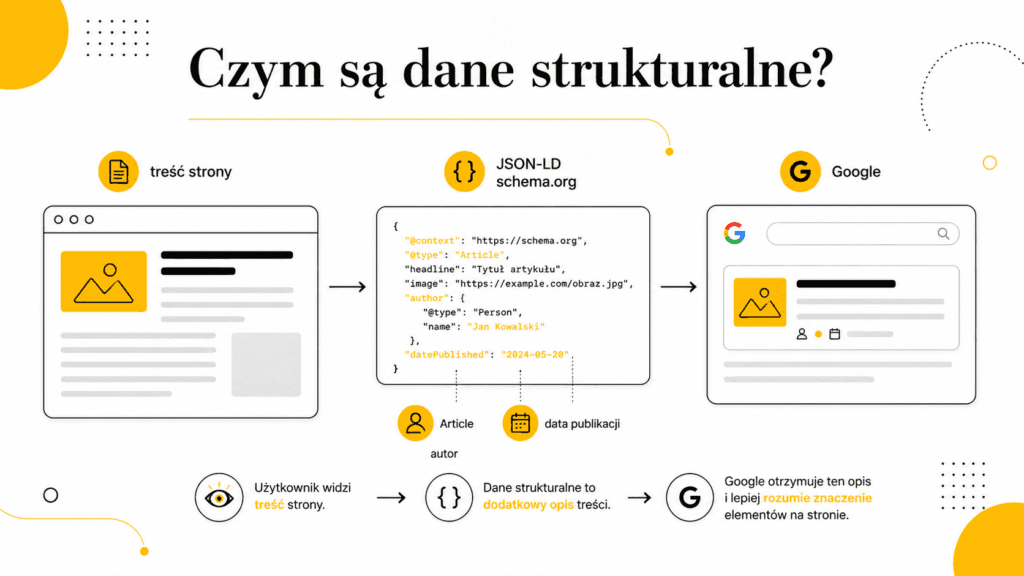
Structured data is an additional description of content written in a standard format that helps search engines recognize the meaning of elements on a page. The most commonly used format is JSON-LD, based on schema.org.
Example: A user sees the headline and paragraphs of an article, while Google can additionally receive information that it is an “Article,” who the author is, when the text was published, and what it is about.
When is it worth implementing schema?
- on expert and blog articles,
- on service and organizational pages,
- in FAQs, if the section is valuable to the user,
- for local business information,
- in e-commerce for products, reviews, and availability.
What mistakes should you avoid?
The most common mistake is marking up data that the user doesn’t actually see on the page. Structured data should describe the content, not create an alternative version of reality.
It’s a good idea to verify the implementation during an SEO audit, because incorrect schema may have no effect or make it harder to interpret the page.
How does Schema support expert content?

For blog posts, structured data can organize information about the publication, author, date, and content type. This aligns well with content marketing, as the technique doesn’t replace quality but helps describe it.
Expert Insight
Structured data is most useful when it stems from the content itself, rather than from a technical checklist. If an article has an FAQ section, schema can describe it. If a company operates locally, the LocalBusiness schema can organize the data. However, if the website lacks substance, schema alone won’t create expertise.
What types of Schema make sense for a company website?
For a company website, it’s usually worth considering data for organizations, articles, FAQs, local businesses, and services. Not every type will be necessary for every site. The choice should be based on the actual content visible on the site, not on the desire to implement as many schema markups as possible.
- Organization or LocalBusiness for company information.
- Article for blog posts.
- FAQPage only where questions and answers are actually part of the content.
- BreadcrumbList for websites with a complex structure.
- Product or Service only when the page actually describes a product or service.
How do you verify the accuracy of structured data?

After implementing the schema, you need to check not only technical validation but also content compliance. Correct code can still be strategically flawed if it describes elements that the user doesn’t see or that the page doesn’t support.
In practice, it’s worth combining this analysis with data from tools, user behavior, and actual business goals. Only then does the topic become more than just a definition—it becomes a decision-making tool.
Example of Application in a Real-World Project
Let’s imagine a situation where a website has articles, services, and FAQs, but the search engine doesn’t receive any additional structured context about these elements. At first glance, this might seem like a single technical or editorial issue, but in practice, it usually involves several layers simultaneously: content, structure, data, UX, and business objectives. This is precisely why structured SEO data should not be analyzed in isolation from the entire website.
The best approach starts with a diagnosis. Before creating a to-do list, you need to determine what is actually hindering performance: a lack of content, an unclear structure, poor measurement, incorrect implementation, or a mismatch with user intent. Only then can you decide which actions have the highest priority and how to measure their impact.
In practice, the process involves: selecting schema types, implementing JSON-LD, and running validity checks in Google tools. This approach prevents you from haphazardly fixing everything at once. Instead, it allows you to select the elements that have the greatest impact on visibility, traffic quality, conversion, or user decision-making.
How can you deepen your analysis before implementation?

Before implementation, it’s worth asking a few key questions. Thanks to them, SEO structured data ceases to be just a buzzword and becomes a concrete decision-making process. The answers to these questions should be based on data, sources, user behavior, and an analysis of the current site structure.
- What user problem is this change intended to solve?
- Does the current website already partially address this intent, or is new content or a redesign needed?
- What data confirms that the problem actually exists?
- Which subpages, forms, campaigns, or content will be affected by the change?
- How will the impact be measured after implementation?
- Will the change cause new cannibalization, duplication, or a deterioration in UX?
FAQ
Does structured data improve rankings on Google?
It is not a direct guarantee of higher rankings. However, it can help Google better understand the page and qualify it for certain types of rich results.
Does every website need schema?
Not every page. It’s worth implementing structured data where it describes real elements of the page and makes sense for the specific type of content.
How can you verify that your structured data is correct?
For basic verification, you can use Google’s Rich Results Test and schema.org validators. After implementation, it’s also a good idea to monitor the reports in Google Search Console.
Summary
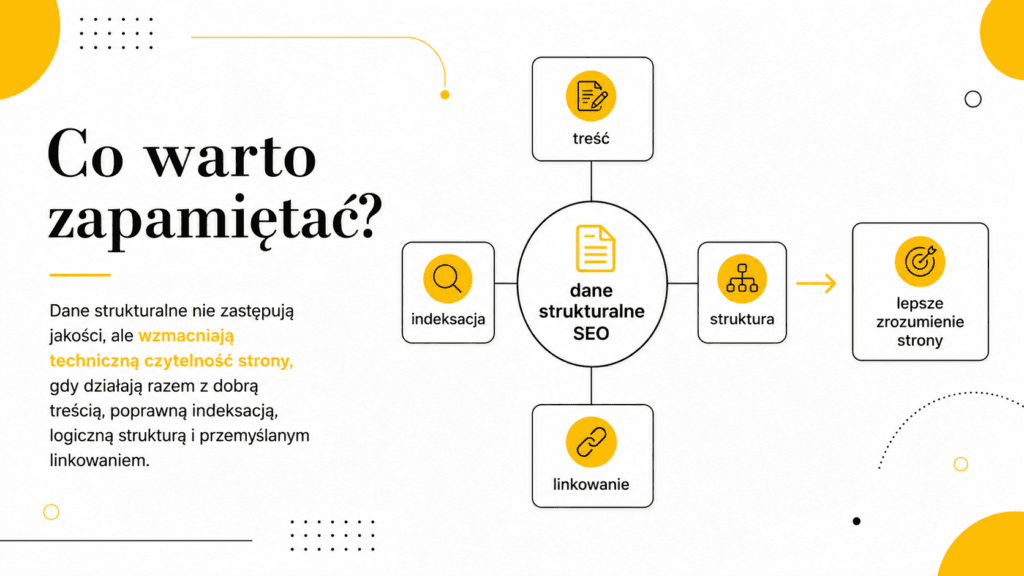
SEO structured data helps clarify the meaning of your content for search engines. It doesn’t replace the quality of your text, but it can enhance the technical readability of your website.
They yield the best results when they’re part of a larger framework: good content, proper indexing, a logical structure, and well-thought-out linking.
Read also: Content gaps in SEO: How to find topics missing from your site?


