Crawl budget: What is it, and when does it matter for SEO?


Not every website needs to be equally concerned about its crawl budget. For small websites with a few dozen subpages, content quality, indexability, and basic technical optimization are usually more important. The situation is different for large websites, e-commerce sites, and sites with thousands of URLs.
The crawl budget describes how many resources Google can and is willing to allocate to crawling a given website. If a site generates a lot of duplicates, errors, or unnecessary URLs, the crawler may waste time on pages that don’t contribute to visibility.
The topic of this post ties in well with SEO audits, because crawling issues often only come to light after analyzing indexing, sitemaps, logs, and URL structures.
You can find more content like this on our blog.
Key Takeaways
Crawl budget is most important for large, frequently updated, or technically complex websites. For small sites, it’s rarely the main limitation to growth.
The problem arises when Googlebot encounters too many unnecessary URLs, errors, duplicates, or low-value pages. In such cases, important content may be crawled less frequently.
Optimizing your crawl budget primarily involves organizing your site structure, reducing junk URLs, and improving indexing signals.
What affects the crawl budget?

- the number of URLs on the site,
- 4xx and 5xx errors,
- technical duplication,
- parameters and filters that generate multiple URLs,
- the quality of the XML sitemap,
- server speed and stability.
When does crawl budget become an issue?
This most often affects large online stores, portals, websites with extensive filters, and sites that have undergone migration. Sorting, parameters, and other technical mechanisms can generate thousands of similar or irrelevant URLs, causing Googlebot to waste resources on pages that do not contribute to the site’s visibility.
In such a situation, it’s worth checking whether the most important subpages are regularly discovered and recrawled by Google. Monitoring this area is one of the key elements of effective SEO.
How can you improve crawl efficiency?
- Remove or fix invalid URLs that shouldn’t be burdening the crawl.
- Make sure the XML sitemap contains only valuable, indexable URLs.
- Minimize duplicates by using canonical tags and organizing parameters.
- Make sure to link to important subpages.
- Monitor indexing reports and crawl statistics in Google Search Console.
What Not to Do?
It’s not worth blocking random sections in robots.txt without understanding the consequences. If the goal is to prevent indexing, robots.txt isn’t always the right tool. That’s why this issue needs to be considered alongside noindex, canonical tags, and the sitemap.
Expert Insight
Crawl budget isn’t a magic growth button. For many projects, improving content, linking, and search intent will yield better results. But for large websites, technical organization determines whether Google can efficiently reach valuable subpages at all.
When does crawl budget become a real problem?
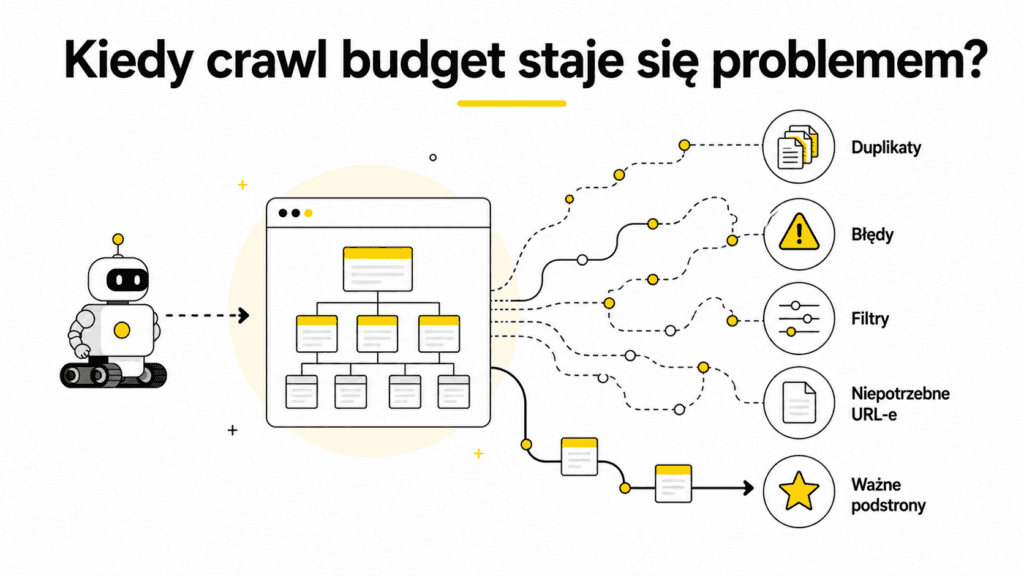
Crawl budget isn’t usually the primary concern for a small service-oriented website. It becomes more important when a site has thousands of URLs, numerous filters, server errors, duplicates, parameters, or frequently updated content. At that point, the question is no longer whether Google can access the site, but whether it can reach the right URLs efficiently enough.
- a large online store with filters and sorting options,
- a website with many URL parameters,
- a website that has been migrated with a large number of redirects,
- a portal with frequent content updates,
- a site with 404 or 5xx errors, or a slow server.
How can you distinguish a crawling issue from a quality issue?
If Google visits a page but doesn’t index its content, the cause may be quality, duplication, or intent—not the crawl budget itself. Therefore, the analysis should cover both the technical aspects and the value of the subpages.
In practice, it’s worth combining this analysis with data from tools, user behavior, and real business goals. Only then does the topic become more than just a definition—it becomes a decision-making tool.
Example of Application in a Real-World Project
Let’s imagine a situation where a large website has many technical URLs, filters, and errors, and important subpages are being refreshed more slowly than they should be. At first glance, this might seem like a single technical or editorial issue, but in practice, it usually involves several layers simultaneously: content, structure, data, UX, and business objectives. This is precisely why crawl budget shouldn’t be analyzed in isolation from the entire website.
The best approach starts with a diagnosis. Before creating a to-do list, you need to determine what is actually hindering performance: a lack of content, an unclear structure, poor measurement, incorrect implementation, or a mismatch with user intent. Only then can you decide which actions have the highest priority and how to measure their impact.
In practice, the process involves analyzing crawl stats, the sitemap, logs, and the quality of crawlable URLs. This approach prevents you from haphazardly fixing everything at once. Instead, it allows you to select the elements that have the greatest impact on visibility, traffic quality, conversion, or user decision-making.
How can you deepen your crawl budget analysis before implementing changes?
Before beginning optimization, you need to determine where Googlebot is actually using resources and whether important subpages are crawled frequently enough. The analysis should be based on data from Google Search Console, the sitemap, server logs, and the site’s structure.
- How many URLs does Googlebot visit per day?
- What percentage of crawled URLs are errors, redirects, and duplicates?
- Does Googlebot crawl parameterized URLs, filtered URLs, and technical variations of URLs?
- Are important subpages crawled regularly?
- Does the XML sitemap contain only indexable URLs?
- Are there any orphaned pages on the site?
- Does the server respond consistently and without 5xx errors?
- Which groups of URLs generate the highest number of unnecessary requests?
How can you determine if crawl budget optimization is a priority?
Not every indexing issue requires crawl budget optimization. For a small website, content quality, internal linking, or incorrect indexing settings may be more important. On a large website, however, the priority may be to reduce the number of parameters, duplicates, and unnecessary URLs.
Crawl budget optimization should be a priority when:
- the site contains thousands or millions of URLs,
- important pages are crawled infrequently,
- Googlebot frequently visits duplicate and technical URLs,
- filters generate many variants of the same pages,
- new or updated content is discovered with a delay,
- logs show a large number of requests to irrelevant URLs.
FAQ
Is crawl budget important for a small business website?
It’s usually not the most important issue. A small website should first focus on indexability, content, speed, and backlinks.
How can I check if Google is crawling my site?
The primary tool is Google Search Console, particularly the indexing reports and crawl statistics. For large websites, analyzing server logs can also be helpful.
Does an XML sitemap increase the crawl budget?
It doesn’t increase the crawl budget on its own, but it helps Google discover important URLs. It should contain only URLs that are actually meant to be indexed.
Summary
It’s worth analyzing your crawl budget when the scale of your site or technical issues might make it difficult for Google to reach important content. This isn’t an issue that affects every website to the same extent.
The best optimization comes down to organization: fewer junk URLs, a better structure, correct canonical tags, a well-organized sitemap, and a reliable server.
See also: SEO Structured Data: How Does Schema Help Google Understand a Website?


