SEO in the Age of Artificial Intelligence – What Changes with AIO and AI Mode?


Until recently, search engine optimization followed a fairly predictable framework. Marketers and SEO specialists focused on keywords, links, technical website parameters, and the race for the top spot on Google. And while this required knowledge and strategy, the rules of the game were more or less known. Today, however, we are facing the biggest transformation in years. Artificial Intelligence Overviews (AIO) and AI Mode have emerged—solutions that are completely changing the way we use search engines.
This isn’t just a cosmetic algorithm update. It’s a new era of search, in which artificial intelligence takes on the role of guide, content curator, and the user’s primary advisor.
The New Face of Search—AI Overviews and AI Mode
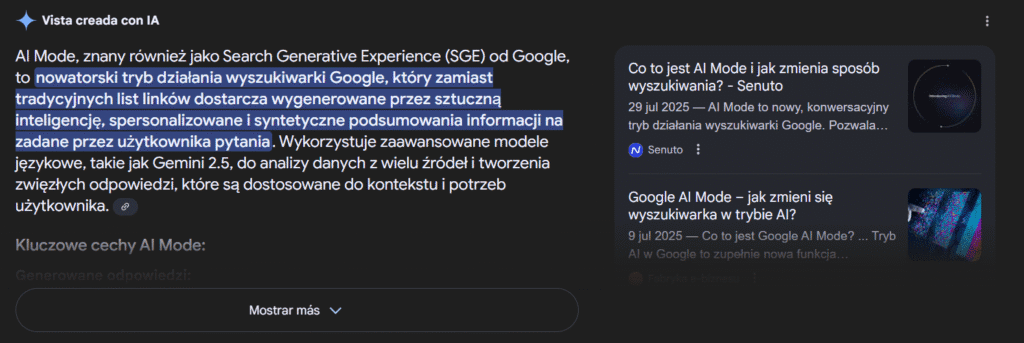
For years, Google has stated that its mission is not only to organize information but also to present it in the most useful form possible. The introduction of AI Overviews and AI Mode is a perfect example of this. But what exactly are AIO and AI Mode?
- AI Overviews are short, AI-generated summaries that appear at the very top of search results. They contain the essence of the answer to a question, often with references to sources. Users thus receive a ready-made answer without having to click through links.
- AI Mode, on the other hand, is a conversational mode with the search engine. Instead of typing in successive phrases and browsing through dozens of results, users can engage in a dialogue, asking for more details. This solution makes using Google feel more like a conversation with a personal advisor.
For the user, this is a huge convenience, as answers appear faster, are more accurate, and are tailored to the intent of the question. But for content creators and brands, this spells a revolution: simply ranking high in search results may no longer be enough.
Risks and Challenges of the New Era of Search
What was once just a test in Google’s labs is now becoming a reality. AI Overviews and AI Mode are being rolled out on an increasingly large scale. What does this mean in practice?
Decline in click-through rates
If a user receives an answer directly in the search engine, their need to click on a link decreases dramatically. Statistics show a drop in CTR of up to 34%. This is a huge blow to websites that have relied on organic traffic for years.
A Shorter Decision-Making Path
Until now, a customer could read several articles, compare reviews, and browse offers. Today, many of these steps are replaced by a single AI summary. From the user’s perspective, this is great. From the brands’ perspective, however, it means less time to build relationships and convince the customer.
A new dimension of competition
In traditional SEO, the competition was for the top 10 results. Now the competition is even fiercer: it’s about whether your brand will be cited by AI in the response or completely omitted.
This shows that we’re entering an era where traditional SEO efforts alone may not guarantee visibility.
What does SEO look like in the AI era?
There’s no doubt that the classic approach to SEO needs to change. This doesn’t mean that all existing practices are obsolete, but they do need to be redefined.
1 Content Designed with AI in Mind
In the past, it was enough to fill the text with relevant phrases and ensure the headings were structured properly. Today, more is required:
- Direct answers to questions—AI looks for content that solves a problem directly. Texts must be written in the style of a how-to guide, a manual, or a list of questions and answers.
- Expertise and authority – articles bearing the author’s name, with references to sources and practical experience, are more credible to AI.
- Variety of formats – text alone is no longer enough. Podcasts, instructional videos, infographics: all of these increase the likelihood that AI will select our content.
- Conversational tone – AI interprets content written in the form of natural dialogue better. The more the content resembles a conversation with a user, the greater the chance it will be used.
2 New Rules of the Game
SEO isn’t just about keywords—it’s also about new ways to measure success:
- New KPIs – instead of obsessing over Google rankings, what matters is visibility in AI Overviews.
- AI-SERP analysis – SEO specialists are beginning to analyze which content is cited by AI and which doesn’t appear there at all.
- Omnichannel – a brand that’s present across multiple channels, consistent, and recognizable is more likely to be identified as a reliable source.
SEO isn’t dying—its old form is coming to an end
Whenever revolutions occur, a dramatic question always arises: “Is this the end of SEO?”
The answer is no. SEO isn’t dying; it’s simply changing shape.
It’s just like the shift to mobile. A decade ago, many companies thought it was just a passing fad. Today, it’s hard to find a business that operates online without a mobile version of its website. AIO and AI Mode represent just such a breakthrough. Not an option, but a necessity for adaptation.
SEO in its new form is becoming more demanding, but also more strategic. What matters now is not just the ability to optimize, but also building brand authority.
Why Can’t You Give Up on SEO?
In the face of these changes, some may decide that continuing the fight is pointless. That’s a serious mistake.
Who stands to lose the most?
- Websites that rely on duplicating competitors’ content.
- Websites that rely exclusively on traffic from long-tail search queries.
- Online stores without a recognizable brand or a unique value proposition.
Why is SEO still necessary?
- AI uses content that already exists. If your brand isn’t there, artificial intelligence simply won’t be able to reference it.
- Strong, expert content increases visibility—it’s this content that most often makes it into AI summaries.
- Competitors will exploit every advantage—companies that understand the rules of the game faster will take the place of those that have fallen behind.
Summary

The era of AI in search is the most significant change in many years. SEO isn’t ending; it’s undergoing a transformation. Instead of fighting for top spots in traditional search results, the goal is now to appear in AI-generated answers.
This requires:
- expert and credible content,
- a presence across multiple channels,
- adapting strategies to the new search landscape.
SEO in the AI era isn’t the end—it’s a new beginning. And those who understand this today will set the standards tomorrow in a world where artificial intelligence decides which content users will see.


