Real-Time Marketing: How Brands Seize the Moment and Win Online

Marketing That Moves to the Rhythm of the Internet
The internet doesn’t wait. A trend can take off in a matter of hours… and die just as quickly.
In a world where news, memes, and emotions operate on a 24-hour cycle, the winners are those who can act right here, right now.
That’s what real-time marketing (RTM) is all about—being part of the conversation that’s already happening.
It’s not a quarterly plan, but instinct in action, backed by a well-designed process.
Brands that understand this don’t just “react”—they participate.
What exactly is real-time marketing?
Simply put: real-time marketing is the ability to communicate with your audience in the context of current events, before the information noise drowns them out.
This could be:
- a reaction to a sporting event (a game, a gala, a broadcast),
- a reference to the premiere of a movie, TV series, or video game,
- a comment on a social or cultural event,
- or simply a witty joke that becomes part of the online memeosphere.
It’s not just about speed. It’s about relevance—ensuring the message makes sense in the context of the brand.
Why is it so effective?
Real-time marketing works because it taps into emotions and a shared sense of experience.
People want to feel that the brand understands the moment—that it’s “here with us,” not just pushing sales messages.
That’s why real-time marketing works:
- Timing builds emotion.
When something happens “here and now,” the audience feels an impulse to react—to laugh, comment, or share. - The brand becomes part of the culture.
Well-designed real-time marketing doesn’t promote a product—it promotes a way of thinking.
And that has a much stronger impact on brand image. - Algorithms favor timeliness.
Facebook, Instagram, and TikTok prioritize content that elicits immediate reactions.
Real-time marketing fits perfectly into this mechanism.
Iconic Examples of Real-Time Marketing
Oreo – “You can still dunk in the dark”
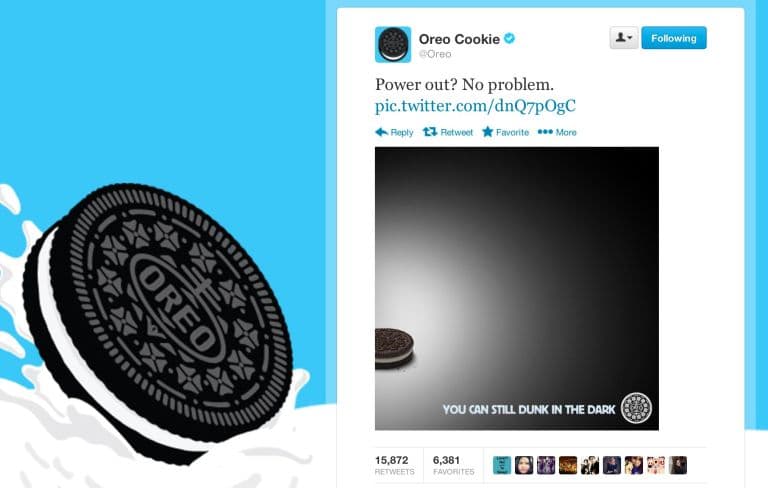
Super Bowl 2013, power outage.
Within 15 minutes, the Oreo team posted a graphic with the slogan:
“You can still dunk in the dark.”
The result? 10,000 retweets per hour, millions in reach, and a place in marketing history.
Real-Time Marketing in Poland—Żywiec, IKEA, Netflix
- Żywiec: During the pandemic—a simple message: “Stay home. We’re taking a break, too.”
Subtle, empathetic, and perfectly pitched. - IKEA Poland: For the premiere of “The Lion King,” it showcased a “Jungle in Your Living Room” display.
- Netflix Poland: responds brilliantly to TikTok trends and pop culture discussions, e.g., following the premieres of its series.
All these examples have one thing in common: RTM isn’t random.
What’s behind effective Real-Time Marketing?
It’s not magic—it’s a system. Behind every quick response lies a process, tools, and a team that’s prepared before anything happens.
-
Rapid Response Team

Real-time marketing can’t go through a three-day approval process.
That’s why successful brands create micro-decision-making teams (copywriter + graphic designer + brand manager) that have the green light to act.
-
Cultural Calendar
This is your “radar eye.”
It includes:
- the most important online holidays (Pizza Day, Star Wars Day, Black Friday),
- sports events (Euro, the Olympics, Champions League matches),
- movie/TV series premieres (e.g., from the Marvel Universe),
- and local events (e.g., elections, festivals, concerts).
This allows you to plan for potential scenarios in advance, rather than reacting in a panic.
-
Tools and Trend Monitoring
Use:
- Google Trends—real-time search term analysis,
- TikTok Creative Center—an overview of emerging trends,
- X (Twitter) Trending Topics,
- Brand24 or Mention—monitoring online discussions.
It’s also worth combining RTM with process automation—read more about this in the article “Marketing with n8n—Automation That Makes a Difference.”
Real-Time Marketing and Brand Storytelling
RTM isn’t just about reacting quickly; it’s also about continuing the brand’s story.
If your RTMs don’t align with your brand’s voice, they become empty jokes.
Key rule:
Don’t react to everything. React to what resonates with your identity.
If your brand is about creativity—react to cultural trends.
If it’s about safety—comment on things that inspire calm and stability.
You can read more about how to create a consistent communication tone in “Building a Company Brand—Why a Brand Is More Than Just a Logo.”
RTM and Sales—Does It Actually Drive Sales?
Yes, but not directly. Real-time marketing isn’t product advertising. Its purpose is to build attention, emotion, and awareness.
Sales are a side effect—though often a powerful one.
The Most Common Mistakes in RTM
- Lack of context.
A comment on a topic that doesn’t fit the brand can trigger a “cringe” reaction. - Too much irony.
Humor is powerful, but there’s a fine line between wit and tactlessness. - Delayed response.
If your RTM appears 24 hours after the trend—it ceases to be an RTM. - Too many RTMs.
Excessive use makes the brand look like a “reactive bot” rather than a dialogue partner.
How to measure the effectiveness of RTMs?
The number of likes isn’t enough. The real value lies in:
- emotional engagement (comments, quotes, memes),
- increased brand awareness in social listening,
- increase in organic brand searches,
- long-term brand image impact (loyalty, recognition).
Data from Sotrender Trends reports show that RTM posts generate, on average, a 40–60% higher engagement rate than pre-scheduled content.
The Future of Real-Time Marketing—Automation and Trend Prediction

Artificial intelligence is also making its way into RTM.
Tools such as Trendify, Notion AI, and Predictive AI for Marketing help detect potential “micro-trends” before they go viral.
But we still need a human to make sense of this data.
Technology can predict the moment—but not the emotions.
How to Get Started with Real-Time Marketing in Your Company
- Set up a simple trend alert system (e.g., using Google Alerts).
- Prepare RTM templates in Canva or Figma.
- Establish a clear decision-making process—who can publish a post without waiting.
- Ensure your brand’s tone of voice is consistent and recognizable.
- Test, analyze, and learn.
Real-time marketing is the art of being where the conversation is happening at the moment when emotions are running high and the audience’s attention is focused on a single event. Effective real-time marketing campaigns aren’t created on a whim, but through a well-prepared process: agile decision-making teams, a cultural calendar, and tools for monitoring trends in real time. Their strength lies in the right context, an authentic tone, and the understanding that the brand doesn’t just react—it becomes part of the culture. Real-time marketing doesn’t sell directly—it builds emotion, attention, and brand recognition, which over time translate into real business results. It’s a discipline where quick thinking, pace, and the awareness that effectively “seizing the moment” begins long before it arrives are what matter most.
Do you want your brand to react faster, smarter, and more creatively?
Contact us—we’ll help you build an RTM system that not only “seizes the moment” but creates them on its own.


