Keyword clustering: How to group keywords without SEO cannibalization?


A list of keywords alone is not yet an SEO strategy. It can serve as a starting point, but it is keyword clustering that allows you to transform scattered phrases into a logical structure of topics, subpages, and articles.
A user entering similar search queries isn’t always looking for the same answer. Sometimes, a single word can shift the intent from informational to transactional. That’s why phrases shouldn’t be grouped solely based on how similar they sound. You need to check what the SERP looks like, what type of content Google displays, and whether specific queries point to the same underlying issue.
Well-executed keyword clustering supports SEO audits, content marketing planning, and website structure design. It also helps avoid situations where multiple articles compete for the same visibility.
You can find more content like this on our blog.
Key Takeaways
Keyword clustering is the process of grouping phrases based on shared intent, similarity in search results, and their role in the site’s structure. Its goal isn’t to create a pretty table, but to decide which queries should lead to a single URL and which require separate content.
The most important criterion is user intent. If two queries look similar but the SERP shows different types of results, they generally shouldn’t lead to the same article.
Well-grouped phrases facilitate content planning, reduce cannibalization, and allow you to build topic clusters that align with user logic.
Why isn’t a simple list of phrases enough?
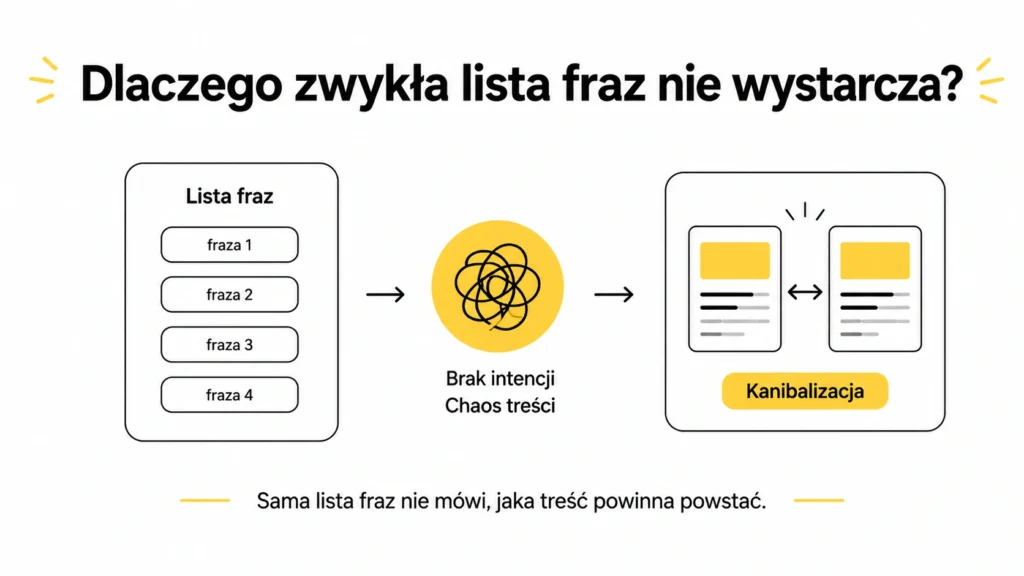
A list of phrases often shows only traffic potential. However, it doesn’t indicate which queries share the same intent, what content already exists on the site, or where the user should be directed after clicking on a Google result.
Without grouping, it’s easy to create several articles that differ in title but answer the same question. Then SEO starts creating chaos instead of growth. This problem is particularly evident when a blog grows rapidly without a topic map.
The post “Customer Journey and SEO” clearly illustrates that users need different answers at different stages of their journey. Keyword clustering puts this principle into practice when working with phrases.
How do you group keywords in practice?
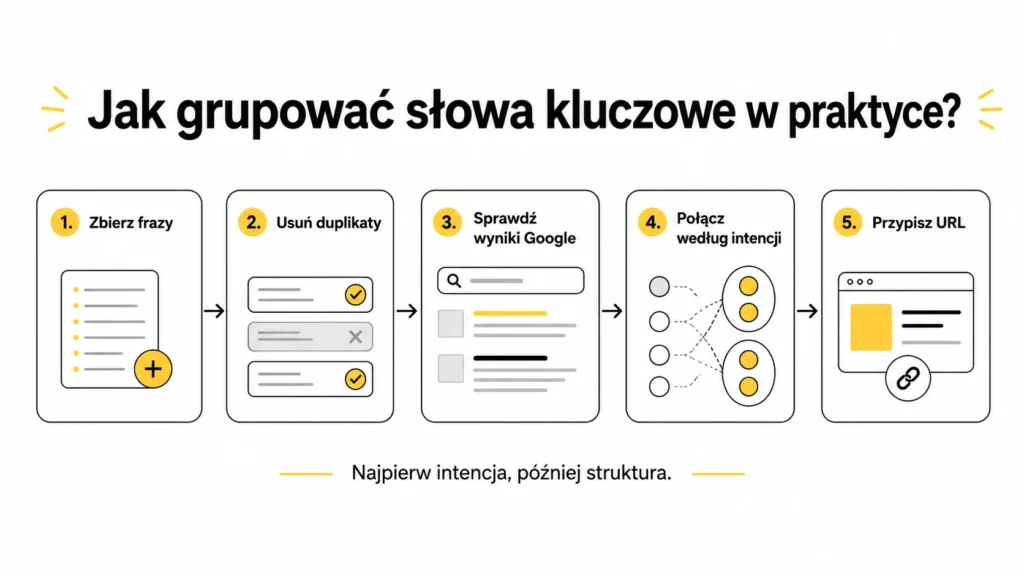
The process should combine data from SEO tools with an analysis of SERPs. Volume alone isn’t enough, because a high-potential phrase may require a completely different page than a seemingly similar query with lower volume.
- Gather phrases from SEO tools, Google Search Console, and competitor analysis.
- Remove duplicates and queries that don’t align with the brand’s offerings or expertise.
- Check the type of results on Google: how-to guides, service pages, categories, tools, videos, or lists.
- Group together phrases that address the same problem and have similar SERPs.
- Assign each cluster to a single target URL.
When should you create a single article, and when should you create separate pieces of content?
A single article makes sense when the phrases lead to the same answer. Separate content is needed when the user expects a different format, a different level of detail, or a different stage in the decision-making process.
Example: “keyword clustering” and “grupowanie słów kluczowych” can be covered in a single article. But “SEO cannibalization” may require a separate article if the user is looking for a diagnosis of the problem rather than the process of grouping phrases.
For complex websites, it’s worth linking clustering to web design, since the URL structure should be based on intent, not a random menu.
Common mistakes in keyword clustering
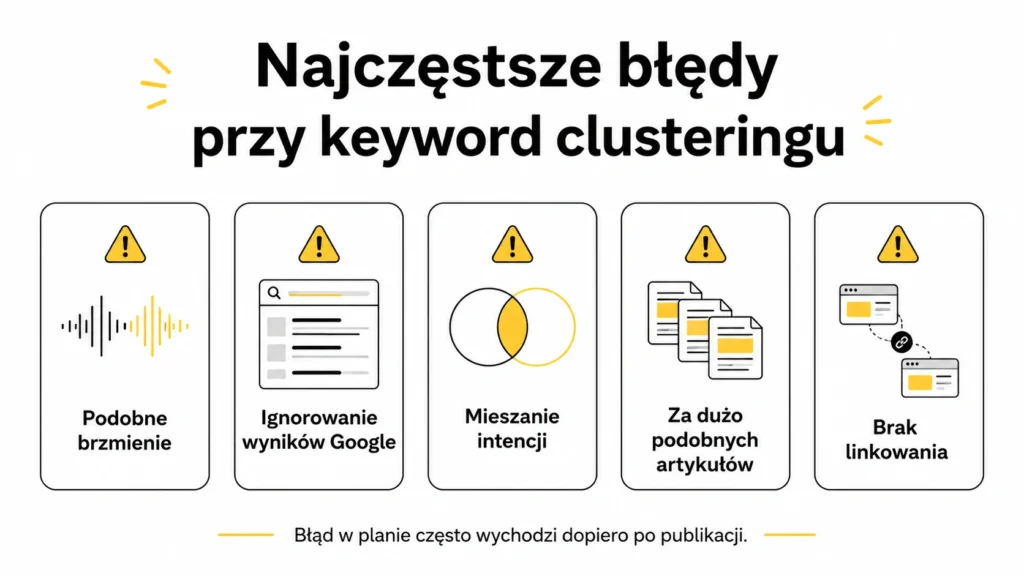
- grouping phrases based solely on similar sounds,
- ignoring SERPs and the type of results,
- combining informational and transactional phrases on a single URL,
- creating a separate article for each language variant,
- failing to link between clusters afterward.
The error may not be visible during the planning stage but becomes apparent after publication. Google begins testing several similar URLs, and none of them achieves a stable ranking. Therefore, when dealing with a larger number of topics, it’s worth revisiting the SEO analysis to verify whether the content strategy has a logical structure.
Expert Insight
Keyword clustering should culminate in an editorial decision, not just a table. The most important question is: Which page should a user see when they enter a given group of search queries? If the answer isn’t clear, the cluster isn’t ready for publication yet.
In practice, good clustering saves time for copywriters, SEO specialists, and content implementers. Everyone can see why a piece of content is being created and what role it’s meant to play in the website’s structure.
Decision Model: One URL or a Separate Article?
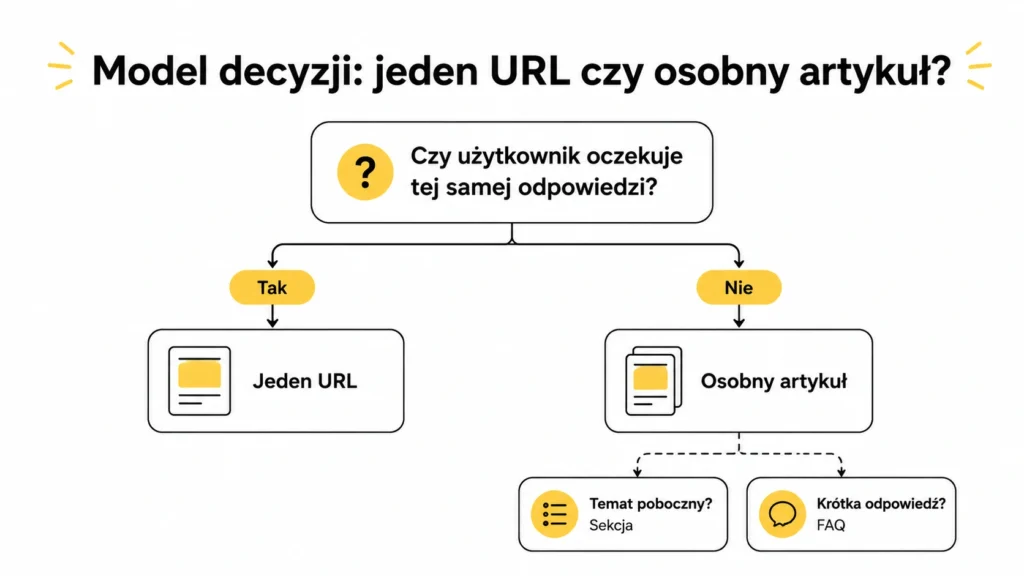
The most difficult part of keyword clustering isn’t naming the cluster. It’s deciding whether a set of phrases should be covered by a single URL or by several separate pieces of content. This decision later affects the blog’s structure, internal linking, keyword cannibalization, and the effectiveness of the entire SEO architecture.
A good test is to ask: Does a user entering these queries expect the same answer? If so, one strong piece of content may be better than three short articles. However, if one query concerns a definition, another a comparison, and the third a technical implementation, combining them into a single piece of content can blur the intent and weaken the match with the SERP.
- One URL: when the phrases have the same intent and a similar type of results on Google,
- separate URLs: when they differ in the decision stage or the format of the expected answer,
- a section within existing content: when the topic is important but doesn’t have a distinct intent,
- FAQ: when the phrase is a side question and doesn’t require a full article,
- service page: when the query is decision-making or purchase-oriented.
Example of incorrect phrase grouping
Imagine that the following phrases end up in a single cluster: “what is an SEO audit,” “SEO audit price,” “SEO audit checklist,” and “technical audit of an online store.” They all share a similar core, but users aren’t looking for the same answer in every case. One person wants a definition, another is considering a purchase, a third wants a checklist, and a fourth has a technical issue with their e-commerce site.
If all these phrases are assigned to a single article, the text will have to educate, sell, instruct, and diagnose all at once. This usually results in content that’s too broad. A better solution is to designate a main page for decision-making intent and supporting articles for informational and technical intent.
How do you check the quality of a cluster after publication?
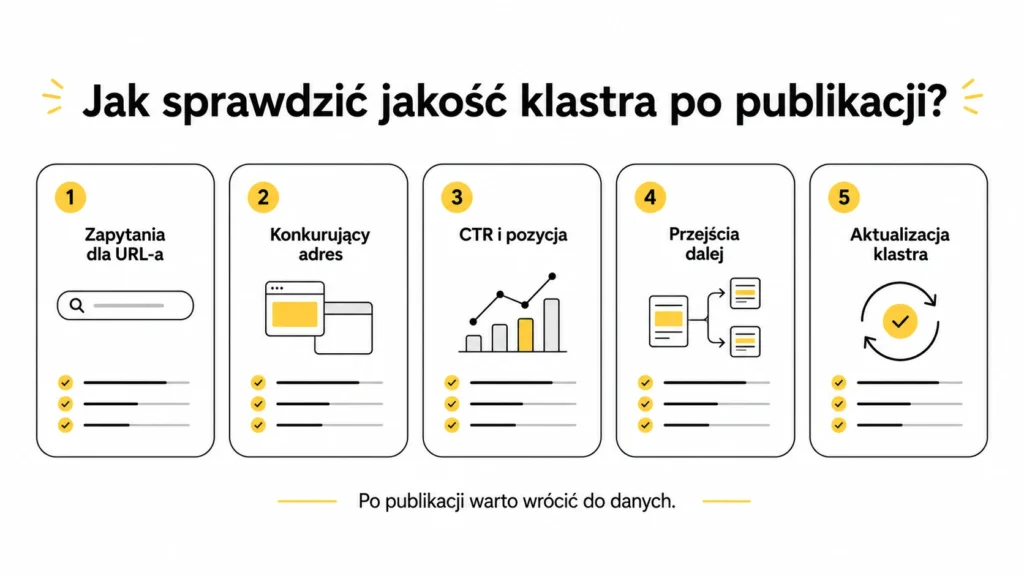
After publication, it’s worth revisiting the data. Keyword clustering doesn’t end with a spreadsheet before you write the text. Google Search Console can show whether a given URL is actually capturing queries from a specific cluster, or if traffic is being spread across several similar articles.
- Check which search queries appear for a given URL,
- see if another URL is competing for similar phrases,
- compare the CTR and average position for the main search queries,
- assess whether users are proceeding to services or related content,
- update the cluster if the SERP starts showing a different type of results.
FAQ
Is keyword clustering necessary for a small website?
Yes, but on a smaller scale. Even with just a dozen or so subpages, it’s worth knowing which phrases lead to the blog, which lead to services, and which don’t fit the site.
Can phrases be grouped automatically?
Tools can speed up the process, but they don’t replace assessing search intent and the SERP. An automatically generated cluster must be verified, because similar words don’t always indicate a similar user problem.
Can a single keyword match multiple URLs?
Yes, but you usually need to designate a primary URL. Other subpages can support the topic through linking, but they shouldn’t compete for the same search intent.
How does keyword clustering help with blog planning?
It allows you to organize topics according to user problems. This helps the blog grow as a system of interconnected content, rather than a list of random posts.
Summary
Keyword clustering streamlines SEO work by turning a list of phrases into a decision-making framework. It helps you choose topics, avoid keyword cannibalization, and assign each article a specific role on the site.
It yields the best results when it combines data from SEO tools, SERP analysis, and an understanding of the user journey. Then, the content not only drives traffic but also guides the reader to the right next step.


