Business Model Canvas. How can you easily assess the state of your business?


When starting a business, the foundation for every entrepreneur is defining their business profile and a plan for growth. This plan should be based on an appropriate strategy. What’s the easiest way to prepare it? Of course, by using the Business Model Canvas, a template that helps organize the collected data. Why is it so important to create the right business model?
What is a business model?
Aleks Osterwalder pioneered the Business Model Canvas with the publication of his book *Business Model Generation: A Handbook for Visionaries*, which was released in 2012. In it, he explains his vision and how to efficiently and easily create a framework for managing and operating a company. Using a graphic diagram divided into nine blocks, he outlines his method, which quickly became one of the most popular strategic management tools! Isn’t it wonderful to be able to draw up such a plan on a single sheet of paper?
The nine elements that make up the Business Model Canvas
The business model framework created by Alex Osterwalder divides a company’s operations into 9 blocks. These can also be grouped into 4 main aspects of the business: customers, offerings, infrastructure, and finances.
- Customer Segments
- Value Propositions
- Distribution Channels (Channels)
- Customer Relationships
- Key Partners
- Revenue Streams
- Key Resources
- Key Activities
- Cost Structure
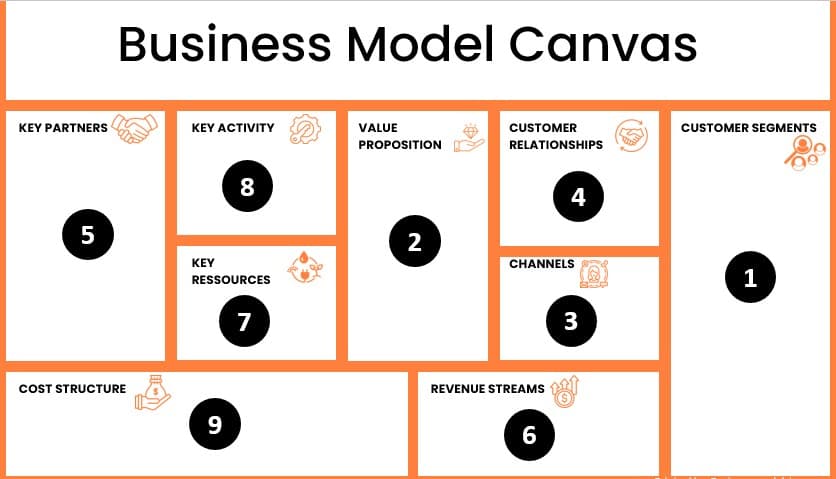
Customer Segments
This is the first and one of the most important points. An entrepreneur must carefully consider who their customers will be and create so-called target groups. Who is the potential customer? For whom are they creating their product? Age, gender, and education are important factors. Who will pay for it?
Value Proposition
This is the second key pillar of a well-prepared business plan. At this stage, you need to pause and focus on the right arguments that will convince the customer that this product is the best solution for them. It’s also important to put yourself in the customer’s shoes when creating the ideal offer! It must be something the customer needs, and—unlike the competition—it must meet their requirements. An attractive price, design, or fast and secure delivery can all be selling points.
Distribution Channels
These are simply the ways to reach customers. Contrary to appearances, this is not as simple as it seems. The entrepreneur’s task is to deliver the product to the customer in a way that satisfies them while also generating a profit for the company. It’s worth considering where your customers are located. Are you targeting a foreign market? Today, online and brick-and-mortar stores are the most important channels.
Customer Relations
Every company’s priority is to continuously acquire new customers and retain existing ones. In this area, communication channels play a crucial role, as they allow customers to place orders, file complaints, or ask questions that are on their minds. These channels can take various forms: phone calls, emails, chats, and even in-person meetings.
Revenue Sources
These determine how profits flow into the company. They allow you to organize the entire payment process—how the customer pays and when the revenue reaches the company. Which method will be most beneficial for the business? Will the business owner offer the option to purchase products in installments? Or perhaps a monthly subscription fee in exchange for using the service? This section helps determine which of these methods will prove to be the most efficient.
Key Resources
One of the key resources needed to start a business is, first and foremost, finances. You also can’t do without physical resources—such as machinery suitable for manufacturing goods. Intellectual resources are also necessary to secure patents and trademarks. Last but certainly not least are human resources, which consist of employees.
Key Activities
We now turn to the most important aspects a company should focus on. Once a business has customers and resources, the entrepreneur must focus on critical matters such as distribution. To sell a product, it must first be manufactured. The next step is problem-solving. This simply means finding solutions to the issues customers bring to your attention. The final step is managing the platform. This involves establishing and maintaining a communication channel responsible for facilitating transactions.
Key Partners
These are none other than the people without whom the company could not function, as not every business can be run alone. This group includes, among others: suppliers, contractors, distributors, and collaborators.
Cost Structure
We’ve reached the simplest section of the entire diagram. It covers such areas as product manufacturing, distribution, and customer relations. This represents the estimated cost of the company’s operations, which is unavoidable. It’s a good idea to fill this out last, after you’ve already completed the previous sections of the table.
The Business Model Canvas: A Simple Way to Assess the State of Your Business
The Business Model Canvas is an ideal starting point for any entrepreneur. It clearly illustrates the individual stages, bringing the business’s purpose into focus. It summarizes the company’s operations, channels, customer interactions, and the profits it generates. It is a simplified business model that can serve as a foundation for creating a more comprehensive and detailed one in the future. The clear visual layout allows the entire team to efficiently organize and prioritize ideas. It’s worth keeping in mind, however, that the simplified diagram alone isn’t enough—the entire process needs to be carried out.
To this day, it remains one of the most popular models used by a large number of companies. It is also worth noting that in recent years, the number of businesses in Poland has increased from 8.2 million to 10.3 million. Over the past two years, salaries have nearly tripled.


