The Customer Journey as a Starting Point for a Marketing Strategy


Why We Start with the Customer Journey
In an era of growing competition and increasingly savvy customers, an effective marketing strategy cannot be built “from the tools up,” but must start with the customer and their experiences. The customer journey is the process of interactions a person has with your brand—from the first contact all the way to post-purchase loyalty. Companies that understand this journey achieve higher engagement, retention, and ROI rates. Their messaging addresses customers’ real needs at every stage of the purchasing decision.
The customer journey is not just an analytical tool. It’s the foundation of a well-thought-out marketing strategy that helps you determine where and how your brand should communicate, what content to create, which channels to activate, and which experiences to optimize so that the customer moves from awareness to purchase and loyalty.
You’ll find more articles like this on our blog—check it out!
What Is the Customer Journey and How Does It Fit Into a Marketing Strategy

The customer journey is the complete sequence of touchpoints a customer has with a brand: from seeing an ad, to visiting the website, to interacting with customer service, all the way through post-purchase experiences and potential referrals to others. Each of these moments influences brand perception and shapes consumer behavior.
In the context of a marketing strategy, the customer journey serves as a starting point because:
- It defines communication goals at every stage of the customer journey.
- It enables precise segmentation and targeting of messages.
- It helps select the tools and channels that best align with user behavior.
- It increases the accuracy of activities and the effectiveness of marketing budgets, minimizing losses associated with “blind” communication.
At the heart of the customer journey lies an understanding of customer behavior and motivations. This requires combining quantitative data with qualitative feedback. Without this, the journey map remains nothing more than an abstract diagram.
Key Stages of the Customer Journey in a Modern Marketing Strategy
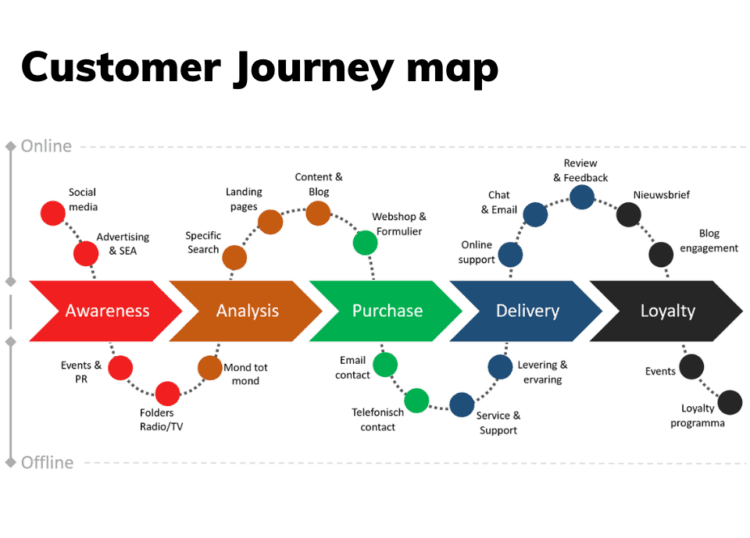
In a modern marketing strategy, the customer journey is most often based on five key stages that reflect the actual way customers make decisions.
The awareness stage is the moment of first contact with the brand, when the customer becomes aware of a problem or need and begins to consider available solutions. Next, the customer moves on to the analysis phase, where they actively seek information, compare offers, analyze educational content, and assess the credibility of the brands they encounter. It is during this stage that preferences and initial purchasing decisions take shape.
The next step is the “purchase” stage—the moment when a decision is made and a purchase is completed. The effectiveness of this stage depends not only on the offer but also on the simplicity of the process and the reduction of decision-making barriers.
After the purchase, the customer journey does not end but transitions into the delivery phase, which includes service fulfillment or delivery, customer service, and the quality of after-sales support. This is the stage that has the greatest impact on customer satisfaction and their evaluation of the entire experience.
The final element of the journey is loyalty—that is, building a long-term relationship with the customer. Regular communication and personalization after the purchase build loyalty, thanks to which the brand becomes the customer’s preferred partner.
This model demonstrates that a marketing strategy based on the customer journey encompasses the entire customer lifecycle, not just the moment of sale. This directly translates into increased customer value and business stability.
Are you a small business looking to improve your local search rankings? Find out what local SEO is. We wrote about it in this post: What Is Local SEO?
Customer Journey Mapping as a Strategic Tool

A customer journey map is a visual representation of the customer’s experience with your brand, showing not only the successive stages but also emotions, motivations, and pain points. It’s a fundamental tool that enables a strategic view of marketing activities.
The map becomes the focal point for key decisions in your marketing strategy:
- it helps identify the moments when users abandon the purchase path,
- allows you to optimize communication and content in response to real needs,
- and highlights touchpoints where automation or personalization is worth implementing.
Companies that continuously update their maps are better able to respond to changes in customer behavior. This allows for faster adaptation of strategies to new market realities.
Customer journey analytics and technologies supporting marketing strategy
Customer journey analytics is not just about maps. Modern analytical tools (customer journey analytics) allow you to track and measure customer activities across multiple channels and identify behavioral patterns. The market for these solutions is growing rapidly. By the end of the decade, its value is expected to reach billions of dollars. Integrating data from multiple channels allows for better prediction of customer intent and increased conversion rates without increasing the budget.
AI technology, including tools like Perplexity, is playing an increasingly important role in marketing. Check out the post: Perplexity AI as a Marketing Tool. How Artificial Intelligence Is Changing the Game.
The Impact of the Customer Journey on Performance and Strategic Goals
Let’s get back to the point: how does the customer journey influence marketing strategy? A deep understanding of the customer journey streamlines planning and resource allocation. Instead of following a cookie-cutter approach, you identify points where customers drop off and implement solutions to minimize losses.
This allows you to:
- increase conversions by better aligning content with decision-making moments,
- reduce customer acquisition costs (CAC) by eliminating ineffective activities,
- increase customer lifetime value (CLTV) through retention strategies and loyalty programs.
It is precisely the integration of the customer journey with your marketing strategy that transforms marketing activities into a cohesive process of customer conversion and retention.
In summary
Today, the customer journey is not just a “nice diagram,” but a concrete tool for organizing your marketing strategy. It allows you to move away from guesswork and focus on actual customer decisions, moments of hesitation, and reasons for churn. As a result, the marketing strategy ceases to be a collection of isolated activities and begins to function as a cohesive process that guides the customer step by step.
Basing the marketing strategy on the customer journey makes it easier to make informed decisions regarding communication, content, and outreach channels. Instead of “being everywhere,” the brand appears where it has real business significance and where it influences purchasing decisions. This is particularly important in the face of growing competition and ever-increasing information overload.
Companies that base their marketing strategy on the customer journey identify sales bottlenecks more quickly and effectively eliminate them. As a result, not only does conversion increase, but so does the quality of customer relationships and the predictability of results. By 2026, this approach will no longer be a competitive advantage but rather the standard for brands focused on scaling and long-term growth.


