Service Website Structure: How to Design a Website That Supports SEO and Sales?


A good service website isn’t just a catalog of information about the company. It’s a carefully designed response to the user’s questions: what you offer, who it’s for, why they should trust you, and what to do next.
The structure of a service website should combine SEO, UX, copywriting, and sales. If any of these elements is missing, the user may visit the site but not proceed to make contact.
This topic complements web design well because it shows that a website doesn’t start with graphics. It starts with the logic of information and the user’s decisions.
You can find more content like this on our blog.
Key Takeaways
The structure of a service page is the layout of sections that guides the user from recognizing the offer to deciding to contact you. It should address the user’s intent, build trust, and dispel doubts.
The most important sections are: the first screen, the problem, the solution, the scope of the service, evidence, the process, FAQs, the CTA, and the contact form.
A good structure supports SEO because it helps assign a specific intent, a main keyword, and logical linking to the page.
What should the first screen look like?

The first screen must quickly explain what the service is, who it’s intended for, and what results it can deliver. It doesn’t need to tell the entire story of the company. Its purpose is to capture the right user’s attention and guide them further down the page.
What sections should you include?
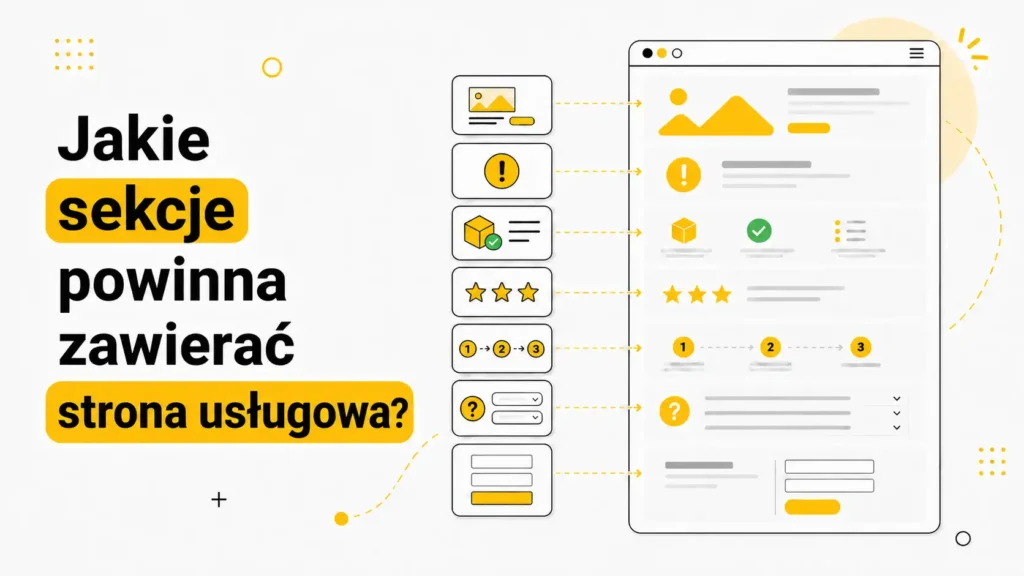
- a clear headline and value proposition,
- a brief description of the user’s problem,
- a description of the solution and the scope of the service,
- evidence: case studies, testimonials, statistics, experience,
- collaboration process,
- FAQs addressing common objections,
- a form or other clear call-to-action (CTA).
How to combine SEO with UX?

SEO helps determine the user’s intent and language. UX helps organize information in an order that’s convenient for the reader. That’s why, for service-oriented websites, it’s worth combining a UX audit with keyword and structure analysis.
Where should you link from a service page?
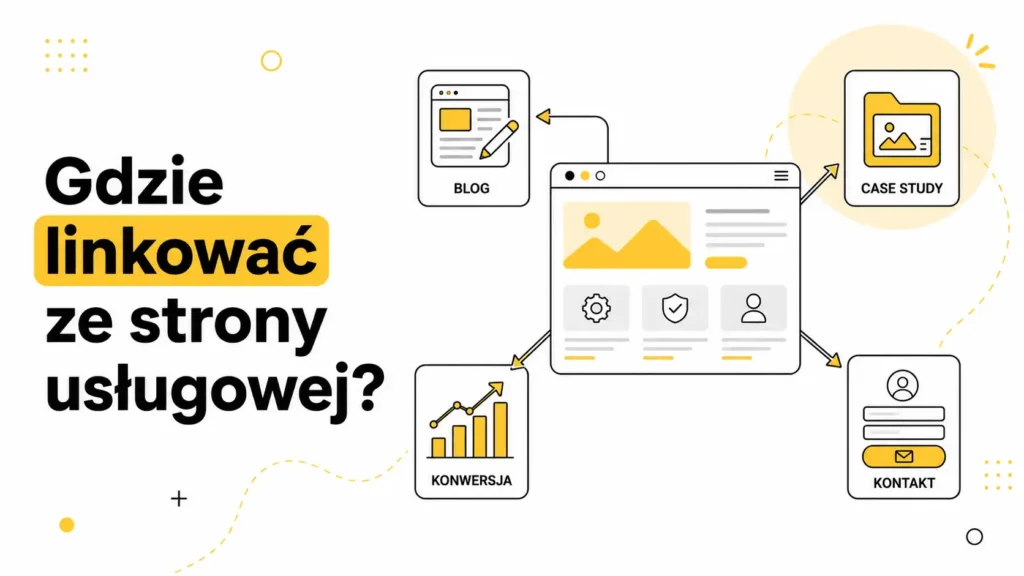
A service page can link to articles that delve deeper into the topic, such as “The Customer Journey and SEO,” posts about conversion, or case studies. A blog, on the other hand, should guide the user from knowledge to the service.
Expert Insight
A service page shouldn’t answer every possible question at once. Its purpose is to streamline the path to a decision. In-depth content can be found on the blog, while the service page should lead to a call to action.
Sections That Should Be Included on a Service Page
An effective service page should guide the user through the decision-making process. First, it must explain where the user has landed and what they stand to gain. Then, it should identify the problem, present the solution, outline the process, establish credibility, and make it easy to get in touch.
- a hero section with a clear message,
- a description of the user’s problem,
- scope and impact of the service,
- the collaboration process,
- evidence of trust,
- FAQs addressing objections,
- CTA and contact form.
Why isn’t the offer alone enough?
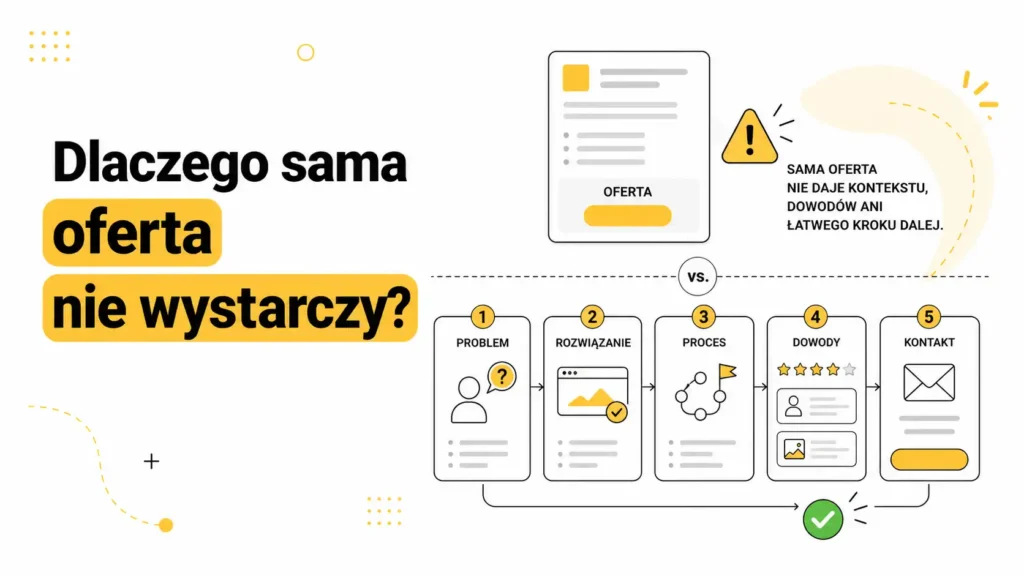
Users often aren’t ready to reach out after reading just one service description. They need to understand whether the problem applies to their situation, what the collaboration process looks like, and whether the company can deliver results. That’s why a service page should serve as a persuasive argument, not just a catalog.
In practice, it’s worth combining this analysis with data from tools, user behavior, and real business goals. Only then does the topic become more than just a definition—it becomes a decision-making tool.
Example of Application in a Real-World Project
Let’s imagine a situation where a website has traffic but fails to guide the user from their problem to making contact and does not address their most significant objections. At first glance, this might seem like a single technical or editorial issue, but in practice, it usually involves several layers simultaneously: content, structure, data, UX, and business objectives. That’s precisely why the structure of a service page shouldn’t be analyzed in isolation from the entire website.
The best approach starts with a diagnosis. Before creating a task list, you need to determine what is actually blocking results: a lack of content, an unclear structure, poor measurement, incorrect implementation, or a mismatch with user intent. Only then can you decide which actions have the highest priority and how to measure their impact.
In practice, the process involves reorganizing the order of sections, messaging, proofs, CTAs, FAQs, and forms. This approach prevents you from haphazardly trying to fix everything at once. Instead, it allows you to select the elements that have the greatest impact on visibility, traffic quality, conversion, or the user’s decision.
How can you deepen your analysis before implementation?
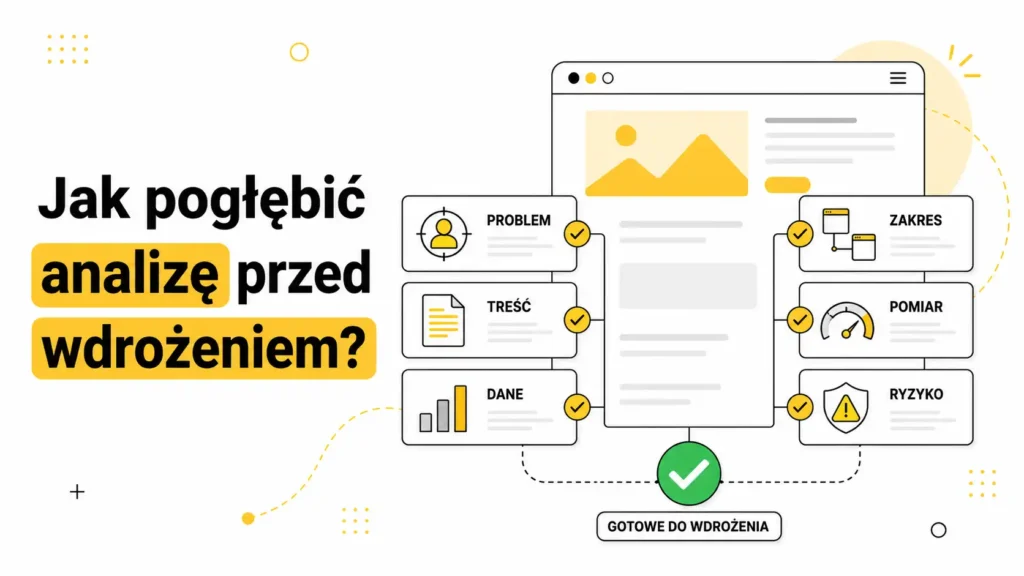
Before implementation, it’s worth asking a few key questions. Thanks to them, the structure of a service page ceases to be just a buzzword and becomes a concrete decision-making process. The answers to these questions should be based on data, sources, user behavior, and an analysis of the current page structure.
- What user problem is this change intended to solve?
- Does the current page already partially address this intent, or is new content or a redesign needed?
- What data confirms that the problem actually exists?
- Which subpages, forms, campaigns, or content will be affected by the change?
- How will the impact be measured after implementation?
- Will the change cause new cannibalization, duplication, or a deterioration in UX?
What should the reader understand after reading this?
After reading a well-written article, the user should understand not only the definition but also the consequences. They should know when the structure of a service page matters, when it’s a secondary issue, how to recognize the problem, and what mistakes to avoid. This is especially important in expert content, because readers often aren’t looking for trivia, but rather a practical answer to the question of what to do next.
It’s also worth outlining the scope of the topic. Not every action carries the same priority for every company. For a small service website, a clear offer and a contact form may be more important, while for a large website, technical indexing checks may take precedence. For a campaign with a small budget, the quality of search queries may be key, while for large-scale campaigns, analyzing conversion paths and attribution may be more important. Premium content should help distinguish between these situations.
Mini-checklist for quality before publication or implementation
- the content addresses the main intent, rather than merely defining a concept,
- Headings guide the user from the problem to the solution,
- examples illustrate real-world scenarios, not abstract ones,
- Practical sections explain what to do and why,
- The FAQ answers the reader’s questions, not the needs of the article’s author,
- sources support specific parts of the content rather than serving as a random bibliography.
If the text meets these conditions, the structure of the service page is explained not only correctly but also usefully. This is what distinguishes an expert article from a basic SEO post: the user doesn’t finish reading with just a definition, but with a real understanding of the problem and possible actions.
FAQ
Should a service page be long?
As long as the user’s intent and decision-making stage require. A simple service may require a shorter page, while a complex B2B partnership needs more explanations, evidence, and FAQs.
Should the CTA be only at the end of the page?
No. A CTA can appear in several places, but it must align with the reader’s stage in the journey. It can be subtle at the beginning and become more direct once the offer has been explained.
Does a service page need an FAQ?
Usually yes, if users have recurring questions about the scope, process, timeline, costs, or results. An FAQ also helps organize content for AI citations.
Summary
The structure of a service page determines whether a user will understand the offer and proceed to contact you. It’s not just a matter of design, but of information strategy.
The best service page addresses the user’s intent, builds trust, guides them through the key points, and eliminates friction at the end of the journey.


