Topical authority: How to build topical authority on Google?


Organic visibility doesn’t grow steadily from individual articles. A single well-written piece may rank for specific search queries, but only a cohesive content strategy demonstrates to Google and users that the site truly understands the subject matter.
This is exactly what topical authority is for. It’s an approach where a blog, service pages, and expert content aren’t a random collection of texts, but a planned roadmap of answers to users’ questions. A well-designed cluster can guide the reader from the basics to a decision, and helps the search engine understand the site’s specialization.
If a company wants to grow organic traffic, a publication calendar alone isn’t enough. You need a topic architecture, intent analysis, and thoughtful internal linking between pieces of content that reinforce one another.
You can find more content like this on our blog.
Key Takeaways
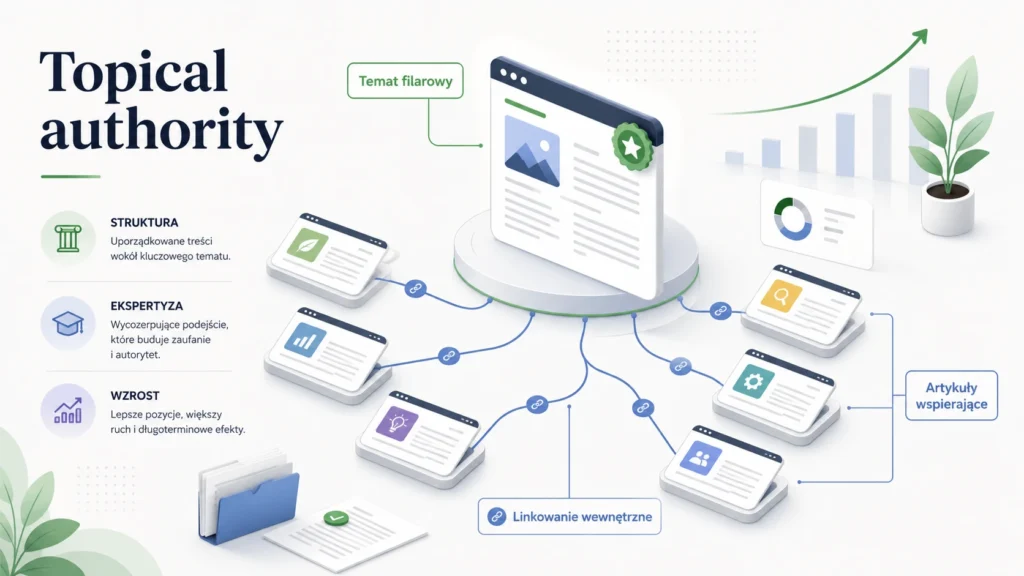
Topical authority refers to a website’s authority in a specific subject area. It is built through comprehensive, useful, and well-connected content, not simply by increasing the number of publications.
The role of each piece of text is what matters most. One article might explain a concept, another solve a problem, a third lead to a purchasing decision, and a fourth clarify technical details. Only together do they form a structure that is clear to both the user and search engines.
In practice, topical authority requires a topic map, unique search intent, logical linking, content updates, and cannibalization control. Without these elements, a blog may generate a lot of content but see little traffic growth.
What is topical authority?
Topical authority can be understood as a signal that a given website consistently and reliably covers a selected topic. It’s not about writing about everything. It’s about answering users’ questions in a specific area better, more comprehensively, and more practically than the competition.
For a marketing agency’s website, an example area could be SEO. A single article on SEO isn’t enough. A much stronger effect is achieved by a whole cluster: keyword analysis, keyword clustering, content gap analysis, internal linking, technical SEO, structured data, and local SEO.
This approach aligns with the logic Google describes regarding helpful content: content should solve the user’s problem and shouldn’t be created solely to rank in search engines. If your current content is scattered, the first step is usually an SEO audit, which identifies which areas need to be organized.
How does topical authority differ from a regular blog plan?
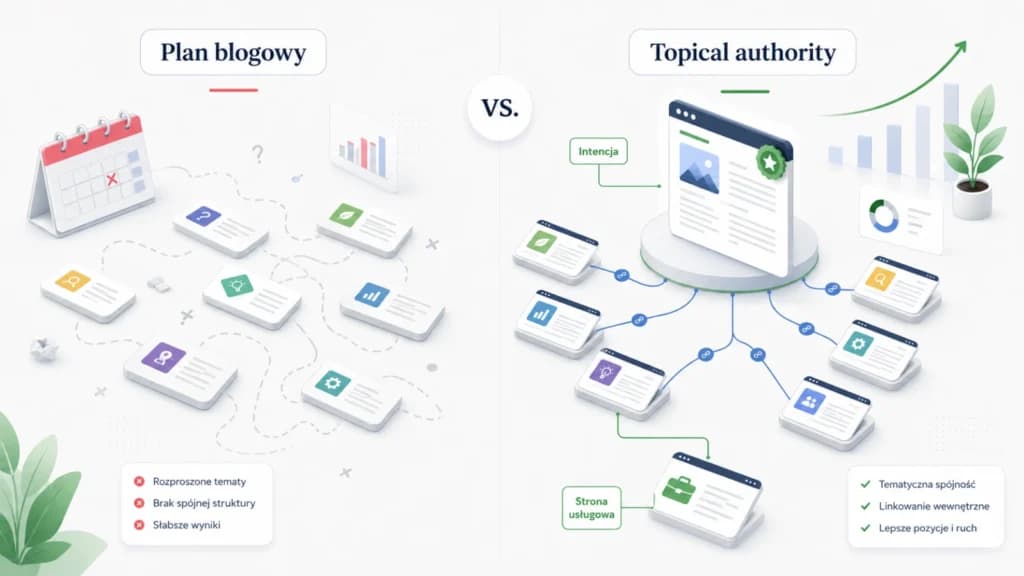
A blog plan answers the question: “What will we publish?” Topical authority answers the more difficult question: “How will all the content work together to improve visibility and influence the user’s decision?”
The difference is significant. A list of topics may look good, but if several articles address the same intent, they begin to compete with one another. Instead of strengthening the domain, they dilute the signals. That is precisely why content development should be linked to content marketing, not just the production of articles.
- A pillar topic organizes the main area of knowledge,
- supporting articles answer more specific questions,
- internal linking guides the user to the next logical step,
- service pages take over at the decision stage,
- updates keep the cluster fresh and credible.
How to plan a content cluster step by step?
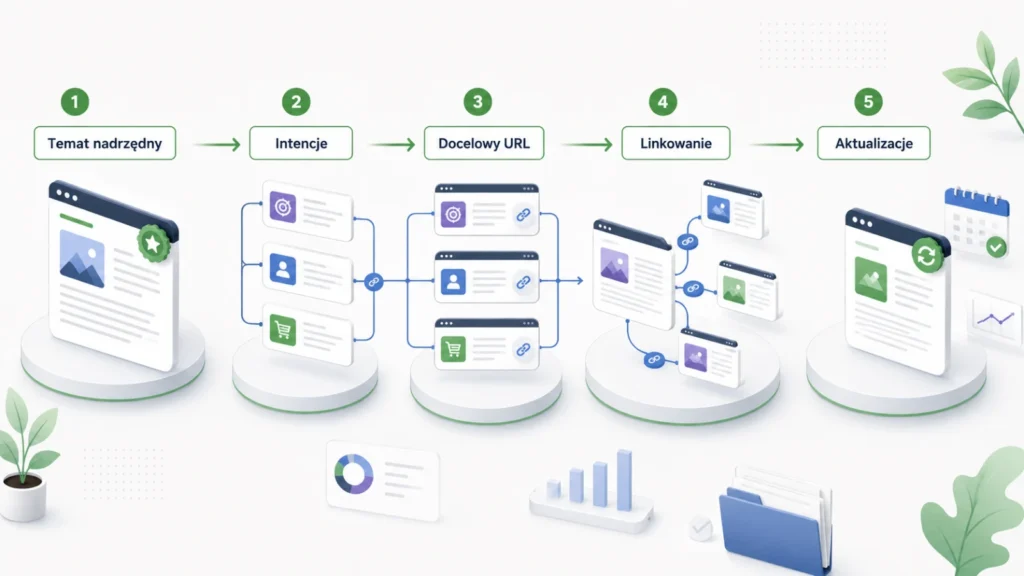
It’s best to start the process by selecting the area where the company actually wants to build visibility. A keyword that’s too broad, such as “marketing,” will be difficult to master. A better starting point is, for example, “SEO for service companies” or “technical SEO for B2B websites.”
- Define the overarching topic and its business objective.
- Gather user questions, phrases, and problems from different stages of the decision-making process.
- Group topics by intent, not just by word similarity.
- Assign one target URL to each intent.
- Plan links between articles, services, and existing posts, e.g., from a text about intent to a post on the Customer Journey and SEO.
This ensures that articles aren’t produced in isolation. Each has a specific purpose: to educate, organize, deepen understanding, or drive engagement. If the topic concerns visibility in organic search results and AI-generated answers, the article “GEO vs. SEO” will also provide a natural context.
What mistakes most often undermine topical authority?
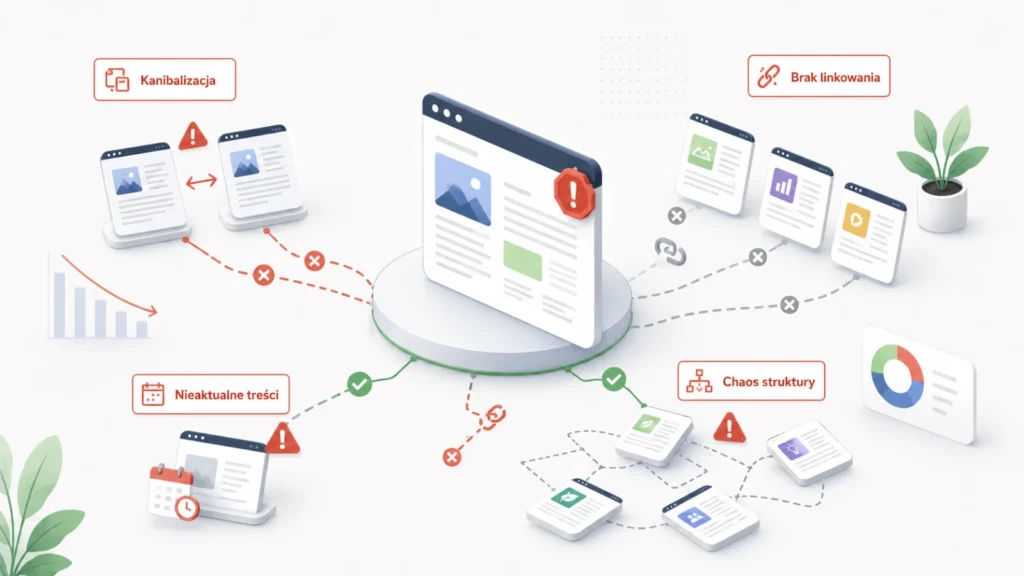
The biggest problem isn’t that a company publishes too little. More often, the problem is publishing without deciding what a given piece of content is supposed to contribute to the website’s structure.
- Several texts address the same intent and cause cannibalization,
- there is a lack of articles supporting the pillar topic,
- the content doesn’t lead to services or other articles,
- sources are random or outdated,
- old posts aren’t updated, even though the SERP or search algorithm has changed.
It’s worth remembering that SEO isn’t a one-time publication. This is well described in the post “Why SEO Is a Process, Not a One-Time Service,” which explains why visibility requires a process, not a single intervention.
How does topical authority support AI citations?
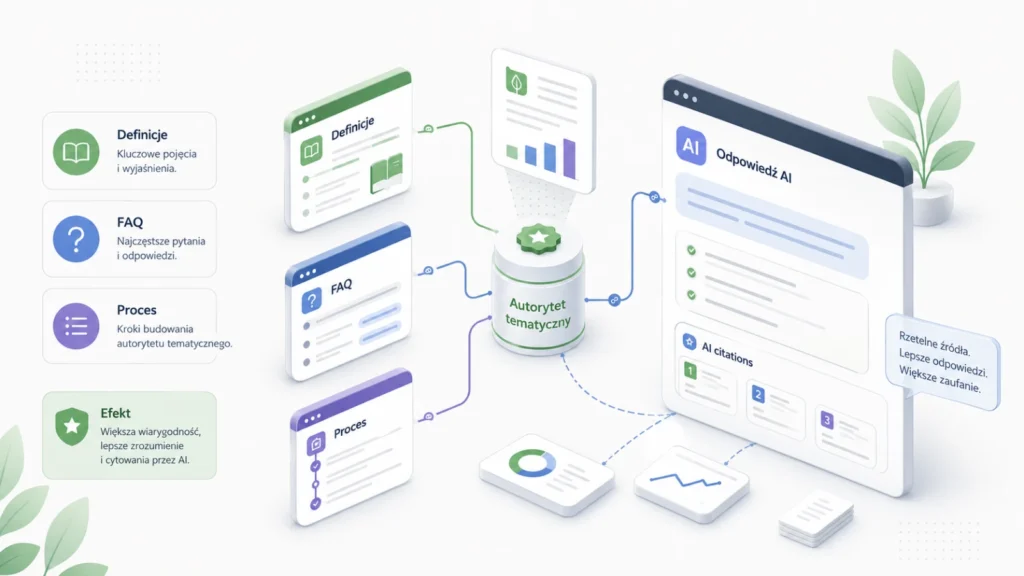
Content designed for topical authority is inherently better organized. It includes definitions, processes, examples, lists, and answers to related questions. This is important not only for Google but also for AI tools that select content snippets that can serve as sources of answers.
This doesn’t mean every text should be written for an algorithm. On the contrary: the clearer, more specific, and more complete the answer for the user, the greater the chance that the content will also be understandable to AI systems. That’s why “Key Information” sections, FAQs, and precise definitions make sense if they stem from intent rather than a mechanical template.
Expert Insight
The best content clusters aren’t built around the question “which phrases have search volume?”, but rather “what decision should the user make after going through this set of content?”. Phrases help set the direction, but it’s the intent and structure that determine whether a blog will drive traffic or just take up space in the index.
If a website already has many articles, developing topical authority often begins not with writing new content, but with organizing what already exists: combining similar content, updating old posts, and improving internal linking.
A practical example of building a topic cluster
Let’s assume a company wants to build visibility around SEO for service-based businesses. The worst approach would be to publish random articles: one about SEO, one about ads, one about conversion, with no clear connection. A better model starts with an overarching theme, such as topical authority, and then breaks down related topics according to user intent.
In this setup, one article might explain topical authority, another might present keyword analysis, another might address content gaps, another might cover linking, and yet another might cover the technical aspects of indexing. The user gets a complete knowledge path, and the site doesn’t end up with several articles answering the same question. This is important because a cluster is meant to be a map, not a pile of papers scattered across a desk.
- The pillar text should organize the main logic of the topic,
- supporting articles should address more specific questions and issues,
- linking should lead from general knowledge to specific details, and then to a service,
- each text should have a distinct purpose, a main phrase, and a clear reason for existing,
- updates should expand the cluster, not create duplicates of it.
How do you assess whether a cluster is complete?
The completeness of a cluster does not mean that every possible topic has been covered. It means that the user can navigate through the most important questions without feeling the need to return to Google for basic explanations. In practice, it is worth checking whether the cluster answers the following questions: what the topic is, how it works, when it matters, what the common mistakes are, how to implement it, and how to measure its impact.
A well-designed topical map should account for different levels of understanding. A beginner needs definitions and examples. A specialist is looking for a process. A business owner wants to know if the topic will translate into traffic, inquiries, or sales. If the cluster addresses only one of these levels, it is still incomplete.
- Does a beginner understand the basics after reading the pillar text?
- Does an advanced user find the process, checklists, and common mistakes?
- do the supporting articles avoid repeating definitions from the main text,
- Are the service pages a natural next step after reading the main text?
- Can you identify which URL corresponds to which intent?
FAQ
Does topical authority depend on writing a large number of articles?
No. The number of articles only matters if each one has a distinct intent and place within the structure. Ten well-connected pieces of content can be more effective than thirty publications answering similar questions.
Can a small business build topical authority?
Yes, but it should narrow down the topic. Instead of trying to cover all of marketing, it’s better to build visibility around a specific area, such as local SEO, service pages, or Google Ads campaigns.
How can you tell if a content cluster is working?
It’s worth analyzing the growth in search volume, organic traffic, queries in Google Search Console, navigation between articles, and assisted conversions. An increase in the number of publications alone isn’t proof of effectiveness.
Does topical authority help avoid cannibalization?
It can significantly reduce the risk if each topic has an assigned intent, a main keyword, and a single target URL. Without this discipline, even a good content cluster can start competing with itself.
Summary
Topical authority is a way to build visibility through a content system, not individual posts. In practice, it requires a topic map, distinct intent, internal linking, and consistent updates.
The greatest value of this approach lies in the fact that it aligns user needs, Google’s logic, and the website’s business goals. The blog ceases to be a repository of posts and begins to function as a purpose-built infrastructure for organic traffic.