GEO vs. SEO – How to Optimize Content for Both ChatGPT and Search Engines


The internet is no longer just a directory of links. It’s becoming a system of answers.
Users are clicking less and less. They’re asking questions. And they get their answers from AI.
In this world, classic SEO isn’t enough, because even the top spot doesn’t guarantee that anyone will see your content.
Enter GEO (Generative Engine Optimization)—an approach that shifts the goal from “ranking high” to “being used.”
This article breaks down the topic in depth and shows:
- how SEO vs. GEO works
- how AI selects sources
- how to design content that gets cited
- how to build an advantage in the new search model
For more content like this, visit our blog.
KEY INFORMATION
SEO is responsible for search engine visibility, while GEO focuses on how AI models use content as a source of answers.
Language models don’t rank pages like Google does; instead, they select the snippets that best answer the user’s question.
The most effective strategy is to integrate SEO and GEO, ensuring that content is both well-indexed and easy for AI to use.
What is GEO (Generative Engine Optimization)?
GEO is a strategy for creating and optimizing content so that it can be used by AI systems as a source of answers.
This is a fundamental shift:
- SEO → “how to be found”
- GEO → “how to be used”
GEO encompasses:
- content structure
- how answers are formulated
- credibility and authority
- alignment with intent
How has search changed?
In the past:
- the user types in a query
- receives a list of links
- selects a result
Today:
- the user asks a question
- AI generates an answer
- links are an add-on
This shift changes everything:
- the number of clicks drops
- the importance of source content increases
- it’s not the first to win, but the one who is cited
SEO vs. GEO – A Complete Comparison
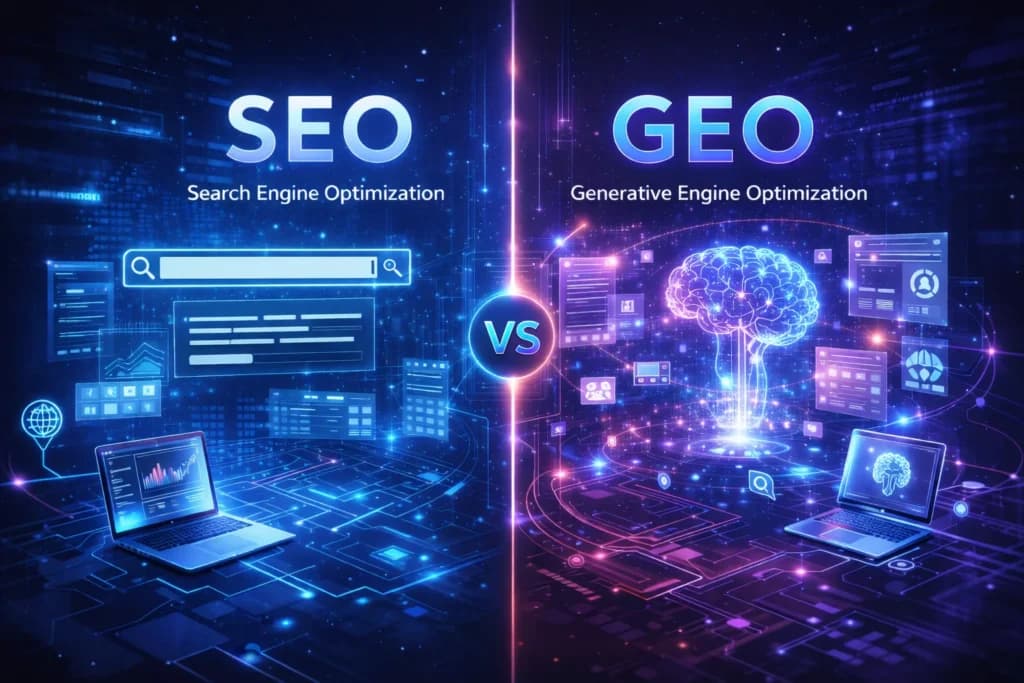
| Area | SEO | GEO |
| Model | ranking | response generation |
| Goal | click | content engagement |
| Unit | page | excerpt |
| Optimization | keywords | meaning and structure |
| Result | list of links | ready answer |
| User role | selects | consumes |
| KPI | traffic | citations / visibility in AI |
How does AI select content?
AI models work differently than Google:
1. Query analysis
AI interprets intent, not just words.
2. Source selection
It selects content based on:
- relevance
- authority
- clarity
3. Extraction of excerpts
Does not take the entire article.
Extracts specific excerpts.
4. Answer synthesis
Combines several sources into a single answer.
Conclusion:
Your product isn’t the article. It’s the answer snippet.
How to Create Content for SEO + GEO
1. Start with an intent map (not keywords)
Goal: to understand what questions users are actually asking—and in what order.
How to do it:
- Collect queries from:
- Google (People Also Ask, autocomplete)
- SEO tools (Ahrefs, Semrush)
- AI (prompt: “What questions will users ask about X?”)
- Group them into clusters:
- informational (what is GEO)
- process-based (how to implement GEO)
- comparative (GEO vs. SEO)
- decision-making (is it worth implementing GEO)
Result:
You create a map of questions that will serve as the framework for the article.
SEO: you cover keywords
GEO: you cover real questions (this is key)
2. Build content using the “Q → A” model (the foundation of GEO)
Each section = an answer to a specific question.
How to write an answer:
- 2–3 sentences (max. 4)
- clear definition or conclusion
- no “introductions” such as: “Nowadays…”
Structure:
- question (H2/H3 heading)
- direct answer (first paragraph)
- only then the elaboration
Example:
“GEO is a topic that is gaining importance…”
“GEO is the process of optimizing content for use by AI models as a source of answers.”
The first sentence must be quotable. This is your “hook for AI.”
3. Create “quotable knowledge blocks” (core GEO)
This is the most important element of the entire process.
The ideal block:
- 2–3 sentences
- one idea
- no dependence on other sections
- contains a definition, conclusion, or instruction
Types of blocks:
- definitions
- comparisons
- instructions (step-by-step)
- lists (bullet points)
- mini-summaries
Technique:
After writing a paragraph, ask yourself:
“Can this section be used as an answer without context?”
If not → revise it.
4. Use an information hierarchy (readability for AI and the user)
AI prefers a logical content structure.
Model:
- Definition (short, specific)
- Explanation (why it works)
- Example (practice)
- Conclusion (what follows from this)
Why it works:
- AI can more easily identify key passages
- Users scan the content faster
This structure improves both search rankings and citability.
5. Design content for scanning (UX + AI parsing)
AI “reads the structure,” not just the text.
Required elements:
- H2/H3 headings as questions
- short paragraphs (2–4 lines)
- bulleted lists
- highlighting of key phrases
Why:
- makes it easier to extract excerpts
- improves readability
- improves UX → impacts SEO
Chaos = lack of citation
6. Use semantic redundancy (smart repetition)
This isn’t about repeating keywords.
It’s about repeating meaning in different forms.
Example:
- definition
- example
- summary
Each one says the same thing, but in a different way.
Result:
- AI has greater confidence in its interpretation
- the likelihood of being cited increases
It’s like “reinforcing knowledge” for the model
7. Build authority (E-E-A-T in GEO practice)
AI prefers content that:
- sounds expert
- is specific
- contains conclusions
How to achieve this:
- add interpretations (not just facts)
- use specifics instead of generalities
- show the “why”
Example:
“GEO is important”
“GEO increases the chance of being cited because AI models select content that is unambiguous and easy to process.”
Expertise = clarity + logic
8. Design FAQ sections (strategically, not “for SEO”)
FAQs are a natural format for AI.
How to create:
- questions = real user queries
- answers = 2–3 sentences
- no fluff
Pro tip:
The FAQ should cover:
- concerns
- objections
- decision-making questions
This is often the most “quoted” part of the article
9. Update your content (freshness + expanding context)
GEO is not a one-time activity.
What to do:
- add new questions
- update data
- expand sections
Why:
- AI prefers up-to-date information
- you increase coverage of search intent
An article is a living system, not a finished product
10. Test visibility in AI (an often overlooked step)
Most people don’t do this.
How to test:
- type questions into:
- ChatGPT
- Perplexity
- Gemini
- check:
- whether your content appears
- which excerpts are used
What to analyze:
- response length
- style
- structure
This is your “feedback loop”
11. Optimize for both worlds simultaneously
The biggest mistake: prioritizing GEO over SEO or vice versa.
Rule:
- SEO → structure, keywords, indexing
- GEO → responses, snippets, clarity
The ideal balance:
- the article ranks
- snippets are cited
This is a hybrid strategy = maximum effect
Read also: The customer journey as a starting point for a marketing strategy.
Final conclusion

You’re not creating an article.
You’re creating:
- a set of answers
- an organized knowledge system
- a structure that AI can use effortlessly
And the article? It’s just the packaging for that logic.
The structure of the ideal GEO-ready article
- definition (short)
- expansion
- step-by-step process
- application
- errors
- FAQ
- summary
Every element = a potential quote.
Most common mistakes (detailed)
- writing “for SEO” instead of for the answer
- Lack of specifics
- Paragraphs that are too long
- lack of structure
- no FAQ
- lack of definitions
- excessive marketing
Worst of all: lack of real value.
FAQ (AI READY)
Will GEO replace SEO?
No. GEO expands SEO and becomes its natural complement.
How do I write for ChatGPT?
Create short, specific answers to user questions that can be used as answer snippets
Do I need to change all my content?
No. It’s enough to optimize key articles and gradually adapt the rest.
What formats work best?
Definitions, step-by-step lists, FAQs, and specific answers.
Does GEO affect traffic?
Yes, but indirectly—it increases brand visibility and the share of AI-generated answers.
EXPERT INSIGHT
The biggest change isn’t about the algorithm. It’s about how we think about content.
Before:
you created an article → optimized it → hoped for a ranking
Now:
you design answers → build an article from them → AI uses them
A New Unit of Competition
You no longer compete:
- a page
- an article
You compete:
with a single snippet of an answer
This is the microscale. And that’s where you win visibility in AI.
What does the “ideal snippet” look like for AI?
The snippet must be:
- unambiguous
- complete
- short
- logical
Example:
“GEO is a modern approach that changes the way…”
“GEO is a process of optimizing content for use by AI models as a source of answers.”
The second excerpt is valuable. The first is an introduction.
The Content Architecture of the Future
The best build:
- an SEO layer (visibility)
- a GEO layer (answers)
It’s like:
- a foundation + a nervous system
One doesn’t work without the other.
Real (strategic) advantage
If you implement GEO:
- Your content starts to “come alive” beyond the website
- it appears in AI responses
- you build authority without a click
This is a new model of content distribution.
The brutal truth
90% of content on the internet:
- does not answer specific questions
- is not quotable
- exists solely for SEO purposes
This means one thing: the space for dominance is enormous.
SUMMARY

SEO ensures visibility. GEO ensures relevance.
In the new search model, it’s not enough to be visible—you have to be useful at the snippet level. It is this level that determines whether your content will be used by AI or ignored.
Today, the greatest advantage is gained by those who stop writing articles as a whole and start designing them as a set of precise answers to specific questions.
Integrating SEO and GEO is not an option, but a necessity—because only content that is both well-indexed and easy for language models to process has a real chance of existing in the search ecosystem of the future.
Are you looking for a partner to lead your marketing efforts? Let us handle it! Feel free to contact us.


